6/29/2026
Carbon Rings: The Silent Protectors of Turbine Reliability
Learn how carbon rings improve steam turbine reliability, reduce steam leakage, increase efficiency, and extend equipment life. Discover their applications, ben
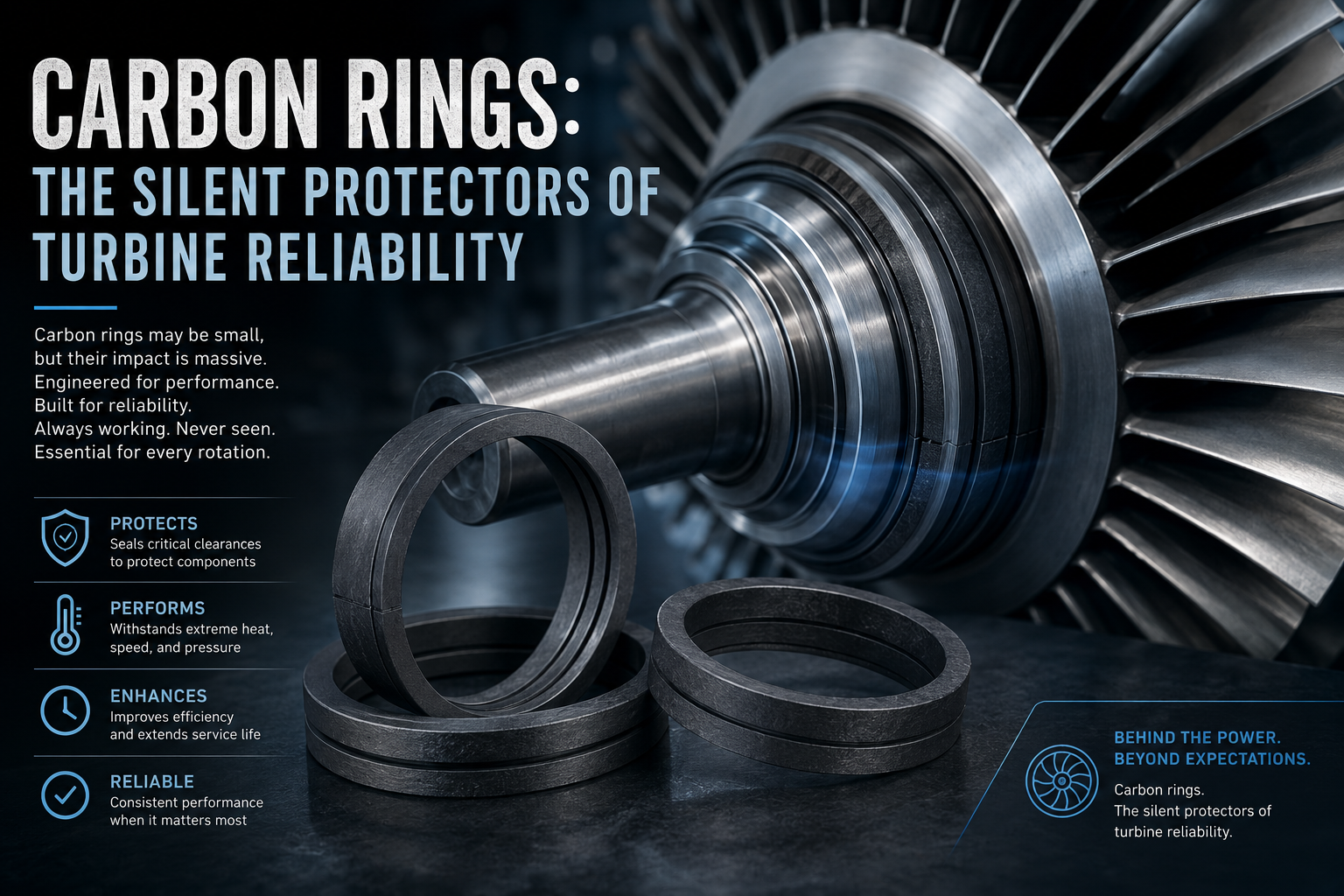
When discussing steam turbine performance, attention often goes to rotors, blades, bearings, and control systems. However, one small yet critical component quietly ensures operational efficiency and reliability—Carbon Rings.
Despite their compact size, carbon rings play a significant role in minimizing steam leakage, maintaining pressure integrity, improving efficiency, and protecting expensive turbine components. A worn or damaged carbon ring can lead to increased operating costs, efficiency losses, and unexpected downtime.
In this article, we'll explore everything you need to know about carbon rings, their working principle, benefits, applications, maintenance, and why they are essential for reliable turbine operation.
Also Read: Why Improvised Supports Are a Serious Risk During Steam Turbine Overhaul
What Are Carbon Rings?
Carbon Rings are precision-engineered sealing components installed around rotating shafts in steam turbines. Their primary purpose is to control steam leakage between high-pressure and low-pressure sections while allowing smooth shaft rotation.
Made from specially formulated carbon graphite materials, these rings offer:
Excellent self-lubricating properties
Low coefficient of friction
High temperature resistance
Dimensional stability
Excellent wear resistance
Unlike metallic seals, carbon rings provide effective sealing without causing excessive shaft wear.
Why Are Carbon Rings Important in Steam Turbines?
Steam turbines operate under extreme conditions involving:
High temperatures
High pressures
Continuous rotation
Thermal expansion
Vibrations
Under these demanding operating conditions, maintaining an effective seal becomes critical.
Carbon Rings help by:
Preventing steam leakage
Maintaining turbine efficiency
Reducing energy losses
Protecting bearings
Maintaining pressure balance
Improving operational reliability
Even minor leakage can significantly reduce turbine efficiency over time.
How Do Carbon Rings Work?
Carbon rings are installed around the rotating shaft with minimal clearance.
As the shaft rotates:
Steam pressure pushes the carbon rings into the sealing position.
The carbon material creates an effective seal.
Minimal contact reduces friction.
Controlled clearance accommodates thermal expansion.
Steam leakage is minimized.
Their self-lubricating characteristics eliminate the need for additional lubrication.
Also Read: How Labyrinth Seals Improve Steam Turbine Efficiency and Reliability
Types of Carbon Rings Used in Steam Turbines
1. Split Carbon Rings
These consist of multiple segments assembled around the shaft.
Advantages
Easy installation
Simplified maintenance
Suitable for large turbines
2. Solid Carbon Rings
Manufactured as a single-piece ring.
Advantages
Better sealing performance
Higher dimensional accuracy
Used in smaller equipment
3. Labyrinth Carbon Rings
Designed with specialized grooves to further reduce steam leakage.
Advantages
Enhanced sealing
Lower leakage rates
Improved turbine efficiency
Key Features of High-Quality Carbon Rings
Premium carbon rings offer several engineering advantages:
Excellent Wear Resistance
They withstand continuous operation for extended service life.
Self-Lubrication
Carbon naturally reduces friction without external lubrication.
High Temperature Stability
Suitable for demanding steam turbine environments.
Chemical Resistance
Resistant to moisture, steam, oils, and industrial contaminants.
Precision Manufacturing
Ensures accurate fit and reliable sealing.
Benefits of Carbon Rings
1. Reduced Steam Leakage
The primary benefit is minimizing steam escape, improving thermal efficiency.
2. Improved Turbine Efficiency
Less leakage means more steam energy is converted into useful mechanical power.
3. Lower Maintenance Costs
Durable materials reduce replacement frequency.
4. Increased Equipment Life
Proper sealing protects shafts, bearings, and surrounding components.
5. Reduced Energy Consumption
Improved sealing directly contributes to lower operational costs.
6. Higher Plant Reliability
Reliable sealing minimizes unexpected shutdowns.
Common Applications of Carbon Rings
Carbon rings are widely used in:
Steam Turbines
Gas Turbines
Turbo Generators
Industrial Compressors
Pumps
Rotating Equipment
Thermal Power Plants
Nuclear Power Plants
Combined Cycle Power Plants
Petrochemical Industries
Refineries
Fertilizer Plants
Signs Your Carbon Rings Need Replacement
Carbon rings gradually wear during operation.
Common warning signs include:
Increased steam leakage
Drop in turbine efficiency
Higher steam consumption
Excessive shaft vibration
Unusual operating temperatures
Pressure imbalance
Frequent maintenance issues
Ignoring these signs may lead to expensive repairs.
Factors Affecting Carbon Ring Life
Several operating conditions influence service life:
Operating Temperature
Higher temperatures accelerate wear.
Steam Quality
Wet steam causes faster erosion.
Shaft Alignment
Misalignment increases uneven wear.
Rotor Vibration
Excessive vibration damages sealing surfaces.
Material Quality
Premium-grade carbon materials offer significantly longer life.
Installation Accuracy
Incorrect installation reduces sealing performance.
Best Practices for Carbon Ring Maintenance
To maximize performance:
Perform regular visual inspections
Monitor steam leakage
Check shaft condition
Measure ring wear during overhauls
Replace damaged segments promptly
Maintain proper shaft alignment
Use OEM-quality replacement rings
Preventive maintenance helps avoid costly turbine failures.
How to Select the Right Carbon Rings
When choosing carbon rings, consider:
Turbine manufacturer specifications
Operating temperature
Steam pressure
Shaft dimensions
Material grade
Operating speed
Plant operating conditions
Expected service life
Working with an experienced engineering partner ensures optimal performance and compatibility.
Why Material Quality Matters
Not all carbon rings are manufactured equally.
High-performance carbon materials provide:
Superior sealing
Reduced wear
Better thermal stability
Longer operational life
Lower maintenance frequency
Higher plant efficiency
Investing in quality components often results in substantial long-term cost savings.
Carbon Rings and Turbine Reliability
Steam turbine reliability depends on thousands of individual components working together.
Although carbon rings represent a small percentage of the turbine's overall cost, they have a significant impact on:
Efficiency
Reliability
Steam consumption
Maintenance intervals
Operational safety
Equipment longevity
A properly functioning carbon ring helps maintain stable turbine performance throughout its operating life.
Why Choose NS Terbo for Carbon Ring Solutions?
At NS Terbo, we understand that every turbine component contributes to overall plant performance. Our engineering expertise ensures precision-manufactured carbon rings designed to deliver reliable sealing, reduced steam leakage, and long-lasting performance. Whether you require replacement components, turbine overhauling, or maintenance support, our team is committed to helping industries maximize efficiency and minimize downtime.
Conclusion
While often overlooked, Carbon Rings are among the most important sealing components in steam turbines. They protect turbine efficiency, reduce steam leakage, extend equipment life, and support uninterrupted plant operations.
By selecting high-quality carbon rings and following proper maintenance practices, power plants and industrial facilities can significantly improve turbine reliability while reducing maintenance costs and energy losses.
If you're looking to enhance the performance of your steam turbine, investing in premium carbon rings is a small decision that can deliver substantial long-term benefits.