9/9/2026
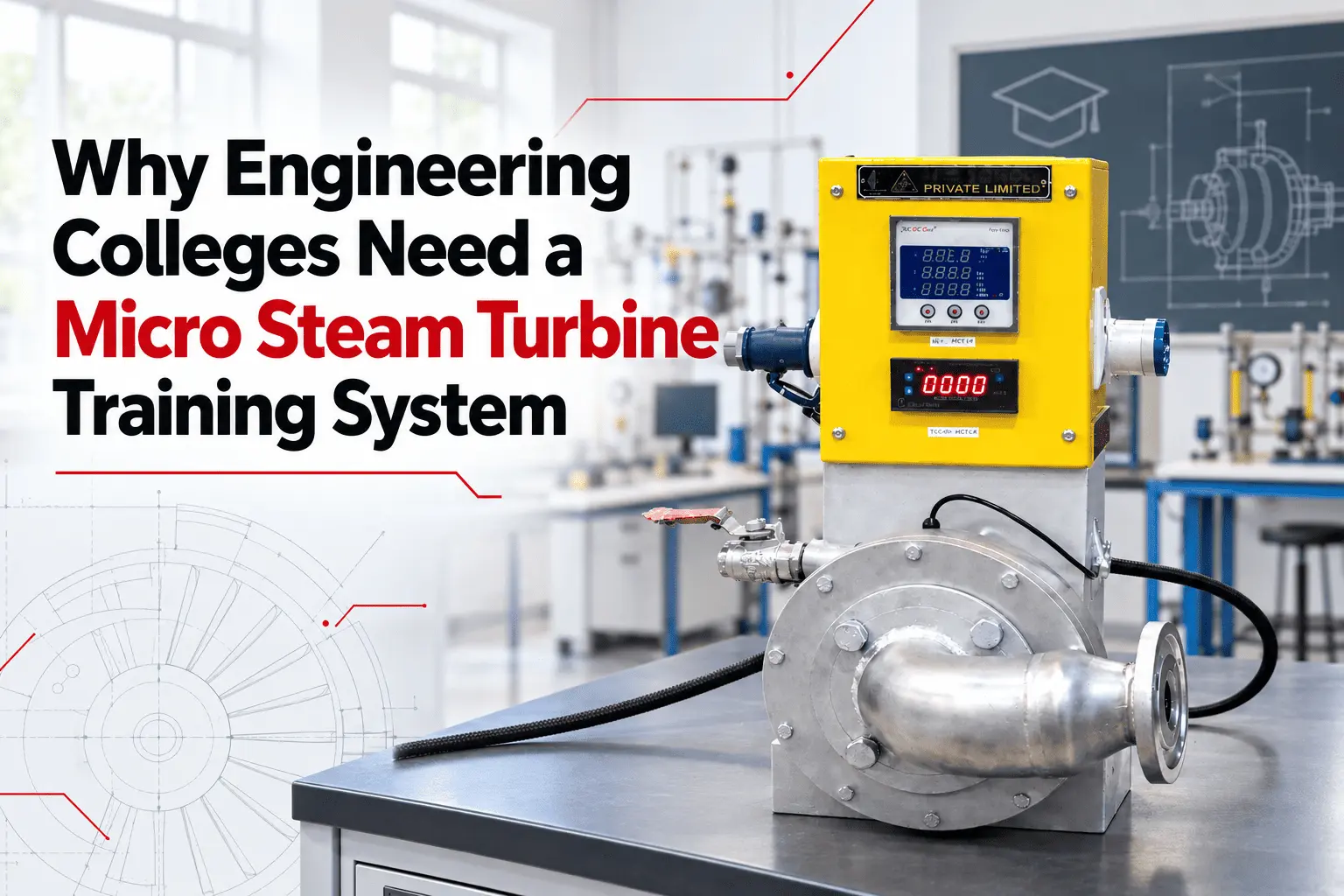
Why Engineering Colleges Need a Micro Steam Turbine Training System
Explore NS Terbo’s micro steam turbine training system for engineering colleges, thermal laboratories, practical experiments and academic research.
Engineering education becomes more effective when students can connect classroom theory with the operation of real equipment. Concepts such as thermodynamics, Rankine cycle, steam expansion, turbine speed, power generation and energy conversion are difficult to understand completely through diagrams and equations alone.
A micro steam turbine training system gives engineering students the opportunity to observe these principles in a controlled laboratory environment. Designed for education, demonstration and research, the system can help colleges strengthen practical learning and prepare students for careers in power generation, mechanical engineering, thermal engineering and energy systems.
What Is a Micro Steam Turbine Training System?
A micro steam turbine is a compact educational unit that demonstrates how steam energy is converted into rotational mechanical energy and, where the system includes a generator, electrical output.
Instead of being used as an industrial power-generation plant, the equipment is installed in engineering laboratories for teaching, experimentation, performance analysis and student projects. Its compact configuration allows faculty members to demonstrate turbine operation while students record and analyse key operating parameters.
Depending on the selected configuration, a training setup may allow students to study:
Steam pressure and temperature
Turbine rotational speed
Steam flow rate
Mechanical or electrical output
Load variation
Efficiency and energy conversion
Inlet and exhaust conditions
Relationships between operating parameters
The final scope and instrumentation should be selected according to the institution's curriculum, laboratory space and learning objectives.
Why Practical Turbine Training Matters
Students often study steam turbines as an important part of thermodynamics, thermal engineering and power-plant engineering. However, without practical exposure, they may understand the equations but remain unfamiliar with actual turbine behaviour.
A micro steam turbine laboratory setup helps bridge this gap. Students can observe steam expansion, turbine rotation, load response and output measurement directly. They can compare theoretical calculations with experimental results and understand why actual performance differs from ideal cycle assumptions.
This makes the laboratory session more than a demonstration. It becomes a structured learning experience involving observation, calculation, analysis and technical reporting.
Suitable Institutions and Departments
Micro steam turbine training systems can be considered by:
Engineering colleges
Polytechnic institutes
Technical universities
Industrial Training Institutes with relevant programmes
Research and development laboratories
Skill-development centres
Vocational and technical training organisations
The equipment is particularly relevant for Mechanical Engineering, Thermal Engineering, Energy Engineering, Power Engineering, Electrical Engineering and interdisciplinary renewable-energy programmes.
Academic Applications
Thermodynamics Laboratory
Students can study the conversion of thermal energy into mechanical work and relate turbine operation to thermodynamic laws. The equipment can support discussions on enthalpy drop, energy balance and system losses.
Thermal Engineering Laboratory
The system provides a practical platform for examining steam properties, turbine performance and the effect of changing operating conditions.
Power Plant Engineering
Faculty members can use the setup to explain the role of steam turbines in power-generation systems. Students gain a clearer understanding of the relationship between steam generation, turbine operation, the generator and electrical load.
Energy Conversion Laboratory
The unit can demonstrate the complete conversion path from steam energy to shaft rotation and electrical output. This helps students understand energy-transfer stages and system efficiency.
Final-Year Projects and Research
With suitable instrumentation and data access, students may use the system for performance studies, control experiments, data acquisition, efficiency analysis and other supervised research projects.
Experiments That Can Be Planned
The exact experiments depend on the equipment design and available instrumentation. An institution may plan activities such as:
Demonstration of micro steam turbine operation
Measurement of turbine speed at different steam conditions
Study of output under varying load
Calculation of power and system efficiency
Comparison of theoretical and experimental performance
Study of steam pressure and flow versus turbine speed
Observation of electrical generation, where a generator is included
Preparation of energy-balance and performance curves
Study of operating and safety procedures
Data acquisition and analysis for student research
Every experiment should be conducted under faculty supervision and according to the operating and safety procedures supplied with the system.
Benefits for Engineering Colleges
Stronger Conceptual Understanding
Students can see how textbook principles behave in a real system. This improves their understanding of thermodynamics and energy conversion.
Improved Laboratory Infrastructure
A compact turbine system can add a specialised experiment to an existing thermal or mechanical engineering laboratory.
Industry-Oriented Learning
Although the unit is intended for education rather than industrial power supply, it introduces students to terminology, measurements, operating logic and safety practices associated with steam-turbine systems.
Support for Curriculum Development
Practical laboratory facilities can support an institution's effort to provide outcome-based, application-oriented engineering education. The suitability of the equipment for any accreditation requirement should be verified against the relevant authority's current standards.
Faculty Demonstration and Student Engagement
A live system makes lectures and laboratory sessions more interactive. Faculty can demonstrate cause-and-effect relationships while students participate in readings, calculations and analysis.
Scope for Research and Innovation
Institutions can configure the system for supervised projects involving performance optimisation, instrumentation, automation, monitoring or educational data analysis.
What Colleges Should Consider Before Purchasing
Before selecting a micro steam turbine laboratory system, an institution should define its academic purpose clearly. Important questions include:
Which course and semester will use the equipment?
Is the system required for demonstration, experiments or research?
What measurements must students record?
How many students will use the setup in one session?
What steam source and utilities are available in the laboratory?
Is digital data acquisition required?
What safety controls and protective devices are included?
Will the supplier provide installation, commissioning and faculty training?
Are operating manuals, experiment procedures and technical documentation available?
What after-sales service and spare support will be provided?
Colleges should not select the unit only on the basis of turbine size or price. The system should match the curriculum, learning outcomes, available infrastructure and expected frequency of use.
Safety and Supervised Operation
Steam is a high-temperature, pressurised medium. Therefore, an educational turbine system requires appropriate controls, instrumentation, protective arrangements and operating procedures.
The laboratory should be prepared according to the equipment manufacturer's requirements and applicable institutional safety rules. Students must operate the system only under trained faculty or laboratory-staff supervision. Appropriate personal protective equipment, controlled access, emergency procedures and routine inspection should form part of the laboratory protocol.
Micro Steam Turbine Educational Solutions from NS Terbo
NS Terbo Pvt. Ltd. provides micro steam turbine solutions for engineering education, laboratory demonstration and academic research. The system can be configured around the institution's teaching objectives, available utilities and required measurements.
Our team can support colleges with technical discussion, configuration, manufacturing, instrumentation, installation and commissioning guidance. Training and documentation requirements can also be discussed during project planning so that faculty members can integrate the equipment into relevant laboratory sessions.
The objective is to provide a practical educational platform through which students can understand steam-turbine fundamentals using observable and measurable operating parameters.
Conclusion: Micro Steam Turbine
A micro steam turbine training system can turn theoretical lessons into a practical engineering experience. It enables students to observe energy conversion, record operating data, calculate performance and understand the behaviour of a real turbine system in a controlled academic environment.
For engineering colleges, polytechnic institutes and universities planning to upgrade their thermodynamics, thermal engineering or power-plant laboratories, the right micro steam turbine setup can add lasting academic value.
Planning a Micro Steam Turbine Laboratory for Your Institution?
Share your department, course, intended experiments, available steam source and instrumentation requirements with NS Terbo for a technical discussion.
Website: https://nsterbo.com/
Phone: +91 95175 66235
Call to Action: Discuss Your College Laboratory Requirement