6/12/2026
Why Are the Front Row Blades Smaller Than Exhaust Stage Blades in a Steam Turbine?
Learn why front-stage blades in a steam turbine are smaller than exhaust-stage blades and how blade design improves turbine efficiency and performance.
Introduction
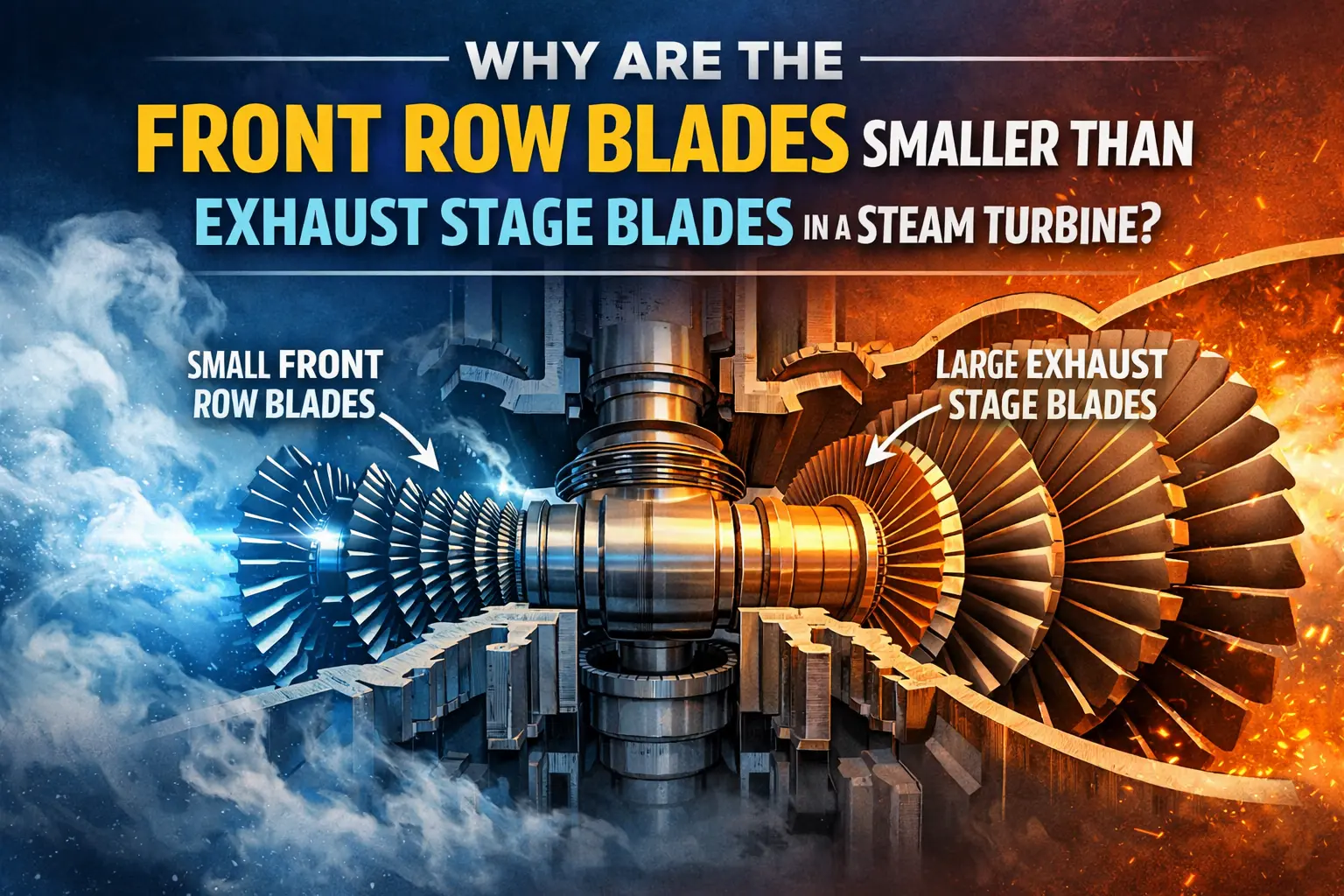
In a steam turbine, one of the most noticeable design differences is the variation in blade size from the inlet stage to the exhaust stage. The blades located in the front rows (high-pressure stages) are significantly smaller than those found in the final exhaust stages (low-pressure stages). This design is not arbitrary—it is a critical engineering requirement that ensures maximum efficiency, reliability, and power generation.
Understanding why steam turbine rotor blades increase in size along the turbine's length helps operators, maintenance teams, and plant engineers appreciate the importance of proper turbine design and operation.
How Steam Flows Through a Steam Turbine
A steam turbine converts the thermal energy of steam into mechanical energy by directing high-pressure steam through multiple stages of rotating and stationary blades.
As steam travels through the turbine:
Pressure gradually decreases.
Temperature drops.
Steam expands significantly.
Specific volume increases dramatically.
Because the steam occupies more volume at lower pressures, the flow passage area must increase to accommodate the expanding steam.
Why Are Front Row Blades Smaller?
1. High-Pressure Steam Occupies Less Volume
At the turbine inlet, steam enters at very high pressure and temperature. Due to its high density, the steam occupies relatively less volume.
Since the steam flow area required is smaller, the initial-stage rotor blades can be shorter and more compact.
Benefits of smaller front-stage blades:
Lower centrifugal stresses
Better structural rigidity
Improved resistance to vibration
Enhanced reliability in high-temperature zones
2. Steam Expands as Pressure Drops
As steam passes through successive stages, its pressure decreases and its volume increases.
To maintain smooth flow and avoid excessive velocity losses, each stage must provide a larger flow area. This is achieved by gradually increasing blade height.
Consequently, the blades become progressively larger toward the turbine exhaust end.
3. Larger Exhaust Blades Handle Increased Steam Volume
In the low-pressure section, steam may occupy several times the volume it had at the turbine inlet.
To efficiently extract the remaining energy from this expanded steam, the exhaust-stage blades are designed with:
Greater blade length
Larger annular flow area
Optimized aerodynamic profiles
Without larger blades, excessive flow restrictions would occur, resulting in pressure losses and reduced turbine efficiency.
Impact on Steam Turbine Efficiency
The gradual increase in blade size plays a major role in maximizing turbine efficiency.
Advantages include:
Reduced steam flow losses
Better energy extraction from expanding steam
Lower exhaust losses
Improved heat rate performance
Higher overall power output
Modern turbine designs carefully optimize blade dimensions at each stage to achieve the highest possible efficiency.
Engineering Challenges of Large Exhaust Blades
While larger blades improve efficiency, they also create engineering challenges.
Higher Centrifugal Forces
Longer blades rotate at high speeds and experience substantial centrifugal loading.
Vibration Risks
Large blades are more susceptible to:
Resonance
Blade flutter
Fatigue failures
Moisture Erosion
In low-pressure stages, steam may contain moisture droplets that can erode blade surfaces over time.
These factors make regular steam turbine maintenance essential for ensuring long-term reliability.
Importance of Steam Turbine Maintenance
Proper steam turbine maintenance helps prevent blade-related failures and extends turbine life.
Routine maintenance activities include:
Blade inspection
Non-destructive testing (NDT)
Dynamic balancing
Rotor alignment checks
Erosion assessment
Vibration analysis
Professional steam turbine service providers use advanced inspection techniques to detect early signs of blade wear, cracking, and fatigue before they become critical issues.
Role of Steam Turbine Manufacturers
Leading steam turbine manufacturers invest heavily in blade design and material technology to improve performance and durability.
Modern rotor blade developments include:
Advanced aerodynamic profiles
High-strength alloys
Moisture-resistant coatings
Integral shroud designs
Optimized vibration damping systems
These innovations allow turbines to operate more efficiently while maintaining reliability under demanding operating conditions.
Steam Turbine Rotor Blade Design Considerations
The design of a steam turbine rotor blade depends on several factors:
Steam pressure
Steam temperature
Rotational speed
Flow rate
Mechanical stresses
Vibration characteristics
Engineers carefully balance these parameters to achieve maximum efficiency and long service life.
Conclusion
The front row blades of a steam turbine are smaller because high-pressure steam occupies less volume at the turbine inlet. As steam expands and its volume increases through the turbine stages, larger blades are required to accommodate the growing flow area and efficiently extract energy. This gradual increase in steam turbine rotor blade size is fundamental to turbine performance, efficiency, and reliability.
Regular steam turbine maintenance and professional steam turbine service are essential to keep these critical components operating safely and efficiently. With continuous innovations from leading steam turbine manufacturers, modern turbines are achieving higher efficiency, longer service life, and improved operational reliability.