9/5/2026
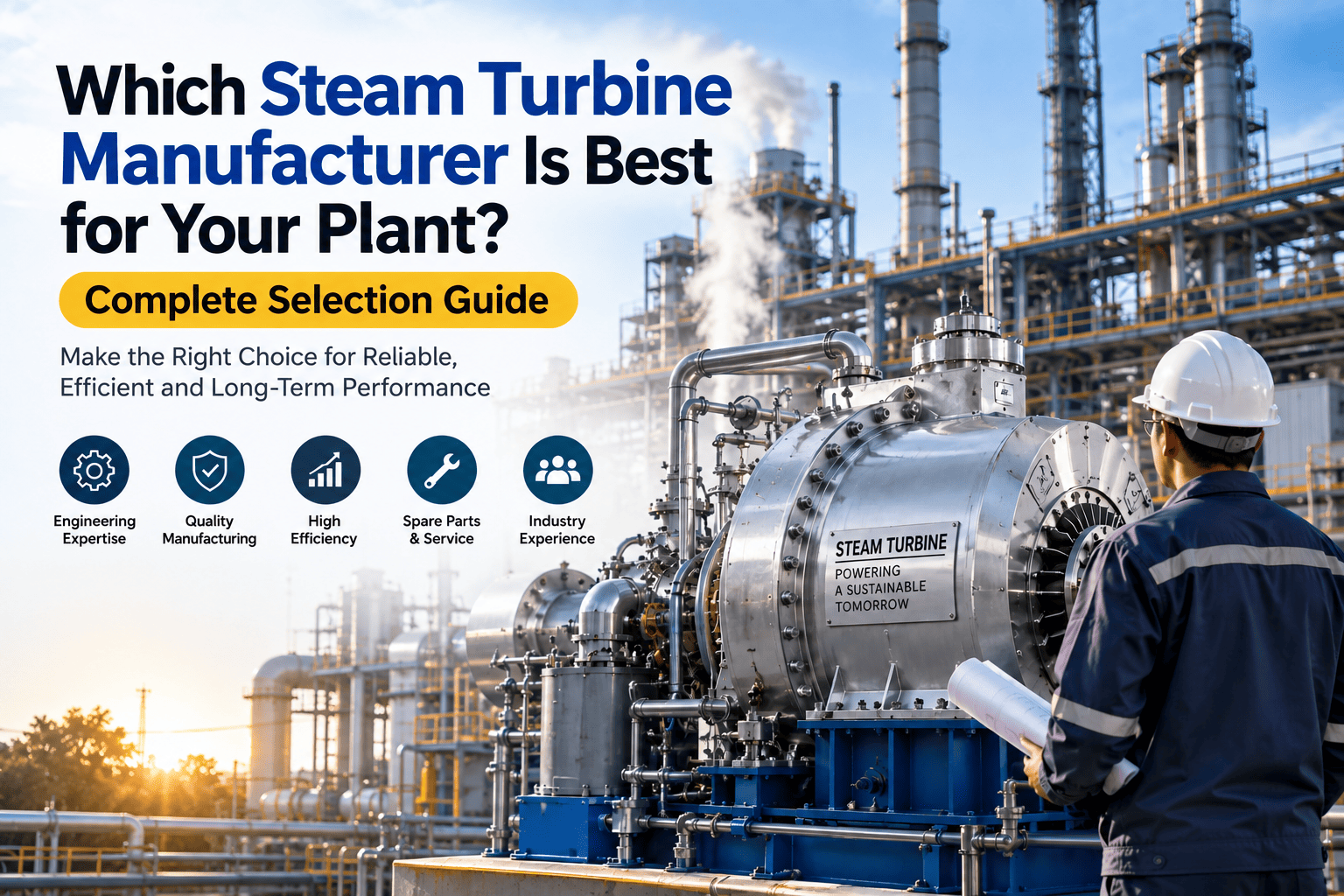
Which Steam Turbine Manufacturer Is Best for Your Plant? Complete Selection Guide
Looking for a steam turbine manufacturer? Learn how to compare efficiency, quality, spares, maintenance and service support for your plant.
Choosing the right steam turbine manufacturer is an important decision for any industrial plant that depends on reliable and efficient power generation. A steam turbine is not simply a piece of rotating equipment; its performance can directly influence plant efficiency, operating reliability, maintenance requirements, and long-term energy costs.
Industries such as sugar, paper and pulp, chemicals, fertilizers, refineries, biomass-based plants, and other process industries use steam turbines for power generation and process requirements. Selecting a turbine only on the basis of initial price may result in higher maintenance costs, reduced efficiency, or operational difficulties later.
A reliable steam turbine manufacturer should therefore offer more than equipment. Engineering capability, turbine selection, manufacturing quality, installation support, spare parts availability, maintenance expertise, and long-term technical service should all be considered.
This guide explains the key factors you should evaluate before selecting a steam turbine manufacturer for your plant.
Why Choosing the Right Steam Turbine Manufacturer Matters
Steam turbines operate under demanding conditions involving high-speed rotation, steam pressure, temperature, and continuous mechanical loading. Even relatively small problems with alignment, bearings, seals, blades, rotor condition, or steam flow can affect turbine performance.
Working with an experienced industrial steam turbine manufacturer can help a plant achieve:
Reliable power generation
Improved operating efficiency
Stable turbine performance
Reduced unplanned downtime
Better equipment reliability
Easier access to critical spare parts
Professional maintenance and overhauling support
Longer equipment service life
The objective should not be simply to purchase a turbine. The goal is to select a technology and service partner capable of supporting the equipment throughout its operating lifecycle.
1. Evaluate the Manufacturer's Engineering Capability
Engineering capability should be one of the first considerations when evaluating a steam turbine manufacturer.
Every industrial plant has different operating requirements. Steam conditions, required power output, process steam demand, operating load, plant configuration, and other technical parameters can vary considerably.
The manufacturer should carefully study parameters such as:
Inlet steam pressure
Inlet steam temperature
Required power output
Exhaust steam requirements
Process steam requirements
Expected operating load
Speed requirements
Generator or driven-equipment requirements
Site operating conditions
Correct turbine selection starts with understanding these parameters.
A manufacturer with strong engineering capabilities can recommend an appropriate turbine configuration instead of treating every project as a standard equipment supply.
2. Check Experience in Industrial Applications
Experience across different industrial sectors is another important selection factor.
Steam turbines are used in several process industries, including:
Sugar and Distillery Plants
Sugar plants can utilize steam generated from bagasse-based boilers for captive power generation and process requirements. Reliable turbine operation is particularly important during continuous crushing seasons.
Paper and Pulp Industry
Paper mills require substantial quantities of steam and electricity. Steam turbine systems can support efficient utilization of available steam while contributing to captive power generation.
Chemical Plants
Chemical processing facilities often operate continuously, making turbine reliability, proper maintenance, and dependable technical support particularly important.
Fertilizer Plants
Steam turbines may be integrated into energy-intensive fertilizer and process facilities where stable operation and equipment reliability are critical.
Biomass and Process Plants
Plants using biomass or other steam-generating systems can integrate turbines to convert available steam energy into useful mechanical or electrical power.
When selecting a manufacturer, evaluate whether the company understands the operational requirements of your specific industry.
3. Consider Turbine Efficiency, Not Just Purchase Price
The lowest equipment quotation does not necessarily represent the lowest long-term cost.
Steam turbine efficiency can influence fuel utilization, steam consumption, power generation, and overall operating economics over many years.
When comparing manufacturers, discuss:
Expected turbine efficiency
Steam consumption
Operating load range
Rotor and blade design
Steam-path condition
Leakage control
Mechanical losses
Performance under actual operating conditions
A technically appropriate and efficient turbine may deliver considerably greater value over its lifecycle than equipment selected primarily on initial cost.
4. Review Manufacturing and Quality Control
Manufacturing quality directly affects the reliability of rotating equipment.
A dependable steam turbine manufacturing company should maintain proper quality-control procedures for critical turbine components.
Important areas include:
Rotor manufacturing and inspection
Turbine blade manufacturing
Shaft dimensional accuracy
Bearing clearances
Labyrinth and sealing systems
Coupling accuracy
Casing inspection
Material verification
Machining tolerances
Rotor balancing
Precision becomes especially important because turbines operate at high rotational speeds. Small dimensional, alignment, or balancing errors can contribute to vibration and premature component wear.
5. Check Steam Turbine Spare Parts Availability
Spare-parts support is frequently underestimated during turbine procurement.
A turbine may remain in operation for many years, during which components can require inspection, refurbishment, or replacement.
Your steam turbine supplier in India should be capable of supporting critical components such as:
Turbine blades and nozzles
White metal bearings
Labyrinth seals
Carbon seals
Couplings
Lube oil system components
Control valves
Emergency stop valves
Bushes
Other turbine components
Easy access to suitable spare parts can help reduce maintenance delays and plant downtime.
Manufacturers with reverse-engineering capabilities may also provide additional support when drawings or original spare parts for older turbines are difficult to obtain.
6. Look for Steam Turbine Maintenance Services
Even a well-designed turbine requires periodic inspection and preventive maintenance.
Before finalizing a manufacturer, determine whether the company can provide comprehensive steam turbine maintenance services.
These may include:
Turbine inspection
Troubleshooting
Bearing inspection
Seal and clearance inspection
Rotor inspection
Alignment checking
Vibration investigation
Component refurbishment
Precision machining
Performance assessment
A manufacturer with both engineering and service capabilities can often identify problems more effectively because its engineers understand turbine construction as well as operating behavior.
7. Evaluate Steam Turbine Overhauling Capabilities
Periodic overhauling is essential for maintaining the condition and reliability of turbines operating continuously.
Professional steam turbine overhauling services may involve dismantling the turbine, inspecting critical components, taking measurements, correcting defects, replacing worn components, reassembling the machine, and checking alignment.
Typical overhaul activities can include:
Turbine dismantling
Rotor inspection
Blade inspection
Journal and thrust-bearing inspection
Seal inspection
Casing inspection
Clearance measurement
Rotor runout checking
Alignment
Balancing support
Component repair or replacement
Reassembly and commissioning support
Choosing a company that can provide these services creates a single technical support point throughout the turbine lifecycle.
8. Installation and Commissioning Support
Correct installation is just as important as correct turbine manufacturing.
Improper foundation conditions, piping loads, coupling alignment, lubrication issues, or incorrect commissioning procedures can negatively affect turbine operation.
Ask whether the steam turbine manufacturer provides support for:
Erection
Installation supervision
Turbine-generator alignment
Auxiliary system checks
Lube oil system inspection
Commissioning
Trial operation
Performance observation
Experienced site engineers can help identify installation-related issues before they develop into serious operational problems.
9. Assess Rotor Repair and Refurbishment Expertise
The rotor is one of the most critical components of a steam turbine.
Over long operating periods, rotors may require inspection, balancing, blade replacement, machining, or other refurbishment work.
A capable service provider should have expertise in areas such as:
Rotor inspection
Rotor runout checks
Reblading
Dynamic balancing
Shaft inspection
Journal restoration
Precision machining
Rotor refurbishment
These capabilities become particularly valuable for plants operating older turbines where complete turbine replacement may not always be the most practical option.
10. Evaluate After-Sales Technical Support
A steam turbine is a long-term industrial asset. The relationship with the manufacturer should therefore continue after commissioning.
Before selecting a supplier, ask:
How quickly can technical support be provided?
Are engineers available for troubleshooting?
Can emergency spare parts be supplied?
Does the company undertake major overhauls?
Can older turbine components be reverse engineered?
Is rotor refurbishment available?
Can the company support equipment throughout its operating lifecycle?
Strong after-sales support can be a major advantage when unexpected turbine problems occur.
How to Compare Steam Turbine Manufacturers in India
When evaluating steam turbine manufacturers in India, avoid comparing companies solely on quoted price.
A more effective evaluation should consider five major areas.
Technical capability: Can the manufacturer understand your steam parameters and recommend an appropriate turbine solution?
Manufacturing capability: Does the company have adequate machining, inspection, balancing, and quality-control capabilities?
Industry experience: Has the company worked with applications similar to your plant?
Service capability: Can it provide maintenance, overhauling, troubleshooting, rotor repair, and refurbishment?
Lifecycle support: Can it supply spares and technical assistance several years after commissioning?
A manufacturer that performs strongly across these areas may provide greater long-term value than a supplier competing primarily on initial equipment cost.
Why Consider NS Terbo for Steam Turbine Solutions?
NS Terbo Pvt. Ltd. provides steam turbine solutions and technical support for industrial power and process applications.
The company's capabilities cover multiple stages of the turbine lifecycle, including:
Steam turbine solutions
Turbine spare parts
Steam turbine overhauling and troubleshooting
Erection and commissioning support
Rotor reblading and refurbishment
Remanufacturing
Reverse engineering of turbine components
Maintenance and technical services
This combination of equipment knowledge and service capability allows industrial plants to work with a technical partner for both turbine requirements and long-term maintenance support.
For plant owners, engineering teams, and maintenance departments, this lifecycle approach can simplify turbine management and help maintain equipment reliability.
Questions to Ask Before Choosing a Steam Turbine Manufacturer
Before placing an order, ask the manufacturer these questions:
Which turbine configuration is suitable for our steam conditions?
What performance can we expect at our normal operating load?
What industries and applications have you previously served?
What quality-control procedures are used during manufacturing?
Can you provide erection and commissioning support?
Which critical turbine spare parts can you supply?
Do you provide turbine overhauling and troubleshooting?
Can you undertake rotor reblading and refurbishment?
Do you provide reverse engineering for older turbine components?
What long-term after-sales support is available?
The answers can help you distinguish between an equipment supplier and a long-term turbine engineering partner.
Final Thoughts
Selecting the right steam turbine manufacturer requires more than comparing equipment prices. Plant owners should evaluate engineering capability, manufacturing quality, turbine efficiency, application experience, spare-parts availability, maintenance expertise, overhauling capabilities, and after-sales support.
A reliable manufacturer should be capable of supporting your turbine from initial technical evaluation and commissioning through routine maintenance, troubleshooting, overhauling, refurbishment, and spare-parts requirements.
For industries where uninterrupted operation is critical, selecting a manufacturer with comprehensive lifecycle capabilities can help improve turbine reliability and reduce avoidable downtime.
Looking for a steam turbine solution for your plant?
Discuss your steam parameters, power requirements, turbine spares, maintenance, overhauling, or refurbishment requirements with NS Terbo Pvt. Ltd.
Frequently Asked Questions
1. How do I choose the best steam turbine manufacturer?
Evaluate the manufacturer's engineering expertise, application experience, manufacturing quality, efficiency considerations, spare-parts support, installation capabilities, maintenance services, and long-term technical support.
2. What information is required to select a steam turbine?
Important information generally includes inlet steam pressure and temperature, required power output, exhaust or process steam conditions, expected operating load, speed requirements, and site-specific operating conditions.
3. Why is after-sales support important when choosing a steam turbine manufacturer?
Steam turbines require periodic inspection, maintenance, spare parts, and overhauling. Reliable after-sales support can help plants address technical issues quickly and minimize maintenance-related downtime.
4. Does NS Terbo provide steam turbine overhauling services?
NS Terbo provides turbine overhauling and troubleshooting services along with inspection, refurbishment, reblading, remanufacturing, and related technical support for industrial turbine applications.
5. Can older steam turbines be refurbished instead of completely replaced?
Depending on the turbine's condition and technical assessment, components such as rotors, blades, bearings, seals, and other parts may be repaired, reconditioned, rebladed, or replaced. A detailed inspection is required before deciding whether refurbishment is technically suitable.