9/5/2026
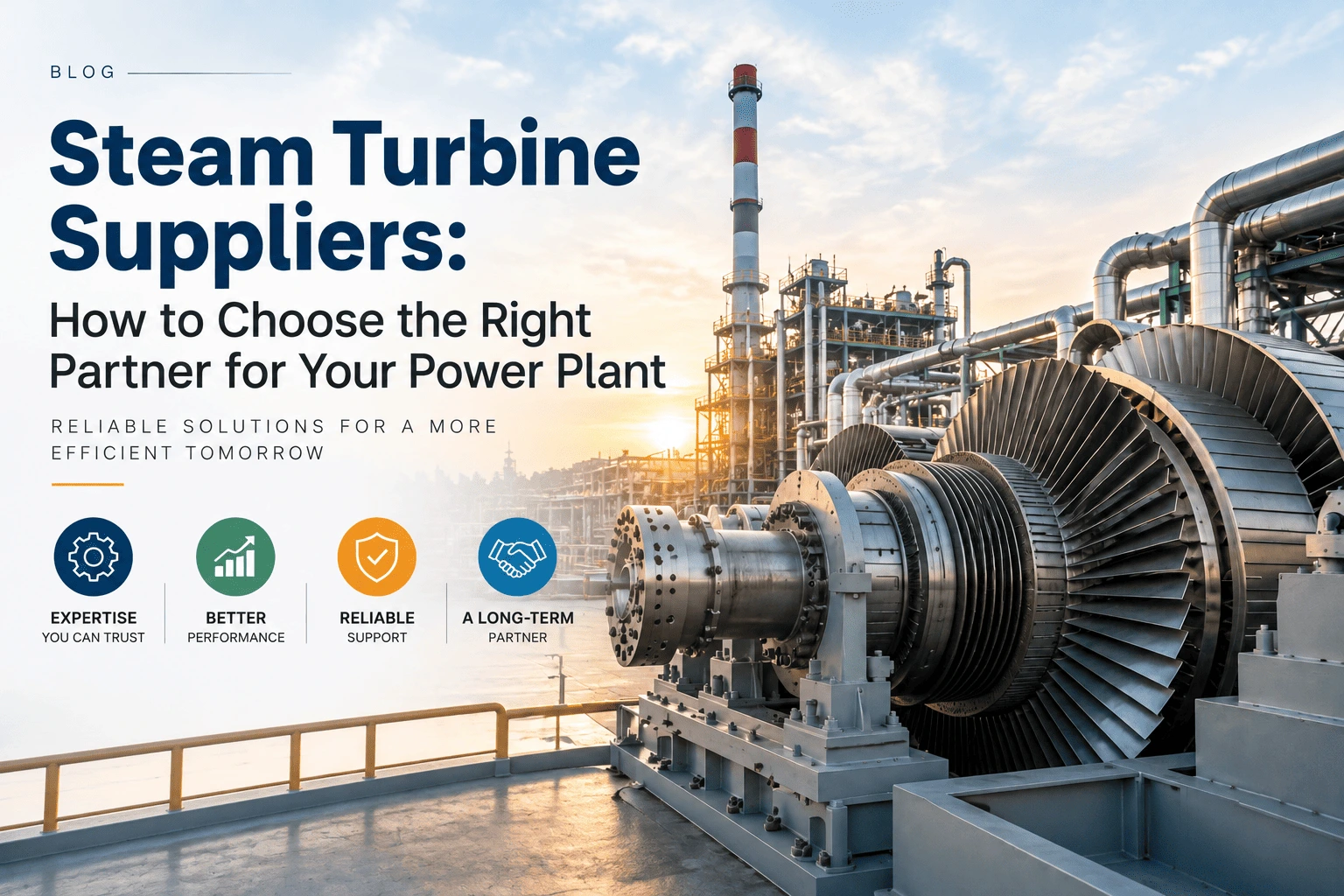
Steam Turbine Suppliers: How to Choose the Right Partner for Your Power Plant
Discover how to choose reliable steam turbine suppliers for industrial plants. Compare expertise, services, spares, performance and support.
Choosing the right steam turbine suppliers is a critical decision for any industrial power generation or process steam project. A steam turbine is not simply another piece of rotating equipment; its performance can directly influence power output, steam utilization, operating reliability, maintenance requirements, and the long-term economics of a plant.
Whether you are developing a captive power plant, cogeneration facility, process industry expansion, or replacing an existing turbine, selecting the right supplier requires much more than comparing turbine capacity and initial price.
Experienced industrial steam turbine suppliers should be able to understand your steam conditions, operating requirements, process demands, expected load profile, and future maintenance needs before recommending a suitable turbine configuration.
This guide explains the major factors industrial buyers, plant owners, EPC companies, consultants, and procurement teams should evaluate when selecting a steam turbine partner.
Why Choosing the Right Steam Turbine Supplier Matters
Industrial steam turbines operate under demanding conditions involving high-pressure and high-temperature steam, continuously rotating components, precise clearances, lubrication systems, control systems, and varying plant loads.
The right steam turbine company should therefore provide more than equipment. A capable supplier should support the complete lifecycle of the turbine—from technical evaluation and engineering to commissioning, maintenance, troubleshooting, spares, and refurbishment.
A poor equipment selection can potentially result in:
Lower-than-expected power generation
Inefficient utilization of available steam
Frequent maintenance requirements
Increased vibration or mechanical problems
Unplanned shutdowns
Difficulty sourcing critical turbine spares
Higher lifecycle operating costs
Limited technical support during emergencies
This is why procurement decisions should consider technical capability, engineering experience, service infrastructure, and lifecycle support alongside commercial pricing.
1. Evaluate the Supplier’s Technical Expertise
Technical capability should be one of the first criteria when evaluating steam turbine manufacturers and suppliers.
Steam turbine selection depends on several operating parameters, including:
Inlet steam pressure
Inlet steam temperature
Steam flow
Exhaust pressure
Required power output
Process steam requirements
Operating load profile
Plant configuration
Available utilities
Site conditions
A professional supplier should study these parameters before proposing the turbine.
Instead of offering a standard machine solely based on MW capacity, the supplier should understand how the turbine will integrate with the overall steam and power system.
For B2B buyers, this engineering capability is particularly important because two plants requiring similar power output may have very different steam conditions and operating requirements.
2. Check Experience with Industrial Steam Turbines
Experience with industrial steam turbines is another important consideration.
Industrial applications can differ significantly depending on the process and operating environment. Steam turbines may be used in industries such as:
Sugar and distilleries
Paper and pulp
Chemical plants
Fertilizer plants
Oil and process industries
Biomass-based power plants
Captive power plants
Cogeneration facilities
Process manufacturing industries
A supplier familiar with industrial applications can better understand changing steam demand, continuous operation requirements, maintenance schedules, process integration, and power requirements.
When comparing suppliers, ask about their experience with projects involving operating conditions similar to yours.
3. Look for Application-Specific Steam Turbine Solutions
There is no single turbine configuration suitable for every industrial plant.
Reliable steam turbine suppliers should evaluate the application before recommending an appropriate solution.
Depending on plant requirements, steam turbine systems may need to support:
Captive Power Generation
Industries with significant electricity requirements may use steam turbines to generate power internally and reduce dependence on external electricity sources.
Cogeneration
Cogeneration systems can utilize steam for electricity generation while making exhaust or extracted steam available for industrial processes.
Process Steam Applications
Industries such as sugar, paper, chemical processing, and distilleries often require steam at specific pressure levels for production processes.
Waste Heat and Energy Recovery
Where suitable steam is generated from recoverable thermal energy, a properly engineered turbine system can help convert part of that energy into useful power.
The turbine supplier should understand the complete application instead of treating the project as an isolated equipment sale.
4. Compare Performance, Not Just Purchase Price
One of the most common mistakes in industrial procurement is focusing primarily on initial equipment cost.
The lowest-priced turbine does not necessarily deliver the lowest lifecycle cost.
When comparing steam turbine suppliers, procurement and engineering teams should consider:
Expected turbine performance
Steam consumption
Reliability
Maintenance requirements
Spare part availability
Service response
Equipment life
Ease of maintenance
Operating flexibility
Even relatively small differences in performance or availability can become financially significant over years of continuous industrial operation.
A lifecycle-based evaluation therefore provides a better basis for decision-making than purchase price alone.
5. Examine Manufacturing and Quality Control Capabilities
Steam turbines contain several precision components that operate under demanding mechanical and thermal conditions.
Depending on the turbine design, critical components can include:
Rotor assemblies
Turbine blades
Nozzles
Bearings
Labyrinth seals
Carbon seals
Couplings
Control valves
Emergency stop valves
Lubrication system components
Ask potential suppliers about their manufacturing processes, inspection procedures, material selection, machining capabilities, balancing practices, and quality assurance systems.
Strong quality control can contribute significantly to turbine reliability and long-term operating performance.
6. Check Installation and Commissioning Support
A technically sound turbine still requires correct installation and commissioning.
Alignment, piping conditions, lubrication, instrumentation, control settings, foundation conditions, and operating procedures can all influence turbine performance.
A reliable steam turbine service provider should be capable of supporting activities such as:
Installation supervision
Erection support
Alignment
Commissioning
Trial runs
Operational checks
Performance observations
Troubleshooting during startup
Having experienced turbine engineers available during commissioning can help identify potential problems before the turbine enters regular operation.
7. Evaluate After-Sales Service Capabilities
For industrial plants, after-sales support can be just as important as the original turbine supply.
Steam turbines are long-term assets that require inspection, maintenance, overhauling, and occasional component refurbishment.
Before finalizing a steam turbine supplier in India or an international supplier, understand the scope of their service capabilities.
Important services may include:
Steam turbine inspection
Troubleshooting
Preventive maintenance
Steam turbine overhauling
Rotor inspection
Reblading and rotor refurbishment
Bearing inspection and replacement
Seal inspection
Alignment support
Rotor balancing
Precision machining
Component remanufacturing
A supplier with strong service capabilities can become a long-term technical partner rather than simply an equipment vendor.
8. Verify Spare Parts Availability
Spare parts availability is another major factor in turbine lifecycle management.
Critical components should be accessible when required because extended waiting periods can increase plant downtime.
Ask potential suppliers about their ability to provide or support:
Turbine blades and nozzles
White metal bearings
Labyrinth seals
Carbon seals
Couplings
Bushes
Control valves
Emergency stop valve components
Lubrication system components
Other critical turbine spares
Suppliers with reverse engineering and remanufacturing capabilities may also be valuable when dealing with older turbines or equipment for which original parts are difficult to obtain.
9. Consider Support for Existing Steam Turbines
Your turbine partner does not necessarily have to support only newly supplied equipment.
Industrial plants often operate turbines that have been in service for many years. These machines may require performance restoration, replacement components, reblading, bearing work, or major overhauling.
Experienced industrial steam turbine suppliers with service and refurbishment capabilities may be able to support existing turbines through:
Condition assessment
Rotor inspection
Clearance checks
Component refurbishment
Reverse engineering
Reblading
Balancing
Alignment
Overhauling
Performance improvement
This capability becomes particularly useful for plants seeking to extend equipment life without immediately replacing the complete turbine.
10. Evaluate Long-Term Lifecycle Support
Steam turbine procurement should be viewed as a long-term industrial investment.
Ask the supplier what happens five, ten, or more years after commissioning.
Can they provide technical assistance? Can they manufacture or source replacement components? Can they overhaul the turbine? Can they inspect and refurbish the rotor?
A strong turbine partner should be able to support the equipment throughout different stages of its operating life.
Questions to Ask Steam Turbine Suppliers Before Finalizing Your Order
Before issuing a purchase order, engineering and procurement teams should ask potential suppliers questions such as:
Have you handled turbines with similar steam parameters?
What information do you require before turbine selection?
How is the turbine configuration selected?
What inspection and quality-control procedures are followed?
What commissioning support is included?
What spare parts can you supply?
Do you provide steam turbine overhauling?
Can you support rotor refurbishment and reblading?
Do you provide troubleshooting support?
Can you support existing or third-party turbine equipment?
What long-term service support is available?
The quality and technical depth of the supplier's answers can help determine whether they are simply selling equipment or capable of becoming a reliable long-term partner.
NS TERBO – Steam Turbine Solutions, Spares and Services
NS TERBO Pvt. Ltd. provides steam turbine solutions and lifecycle support for industrial power and process applications.
With experience in the steam turbine sector since 2004, NS TERBO supports industrial customers with turbine-related engineering, spares, maintenance, refurbishment, and field services.
Our capabilities include:
Steam Turbine Services
Steam turbine overhauling and troubleshooting
Erection and commissioning support
Rotor inspection
Reblading and refurbishment of rotors
Alignment and balancing support
Bearing and seal inspection
Component remanufacturing
Performance and reliability improvement support
Steam Turbine Spares
NS TERBO supports requirements for components including:
Turbine blades and nozzles
White metal bearings
Labyrinth and carbon seals
Couplings
Lubrication system components
Control valves and emergency stop valve components
Bushes and other turbine spares
Reverse-engineered components
Our objective is to support industrial customers throughout the turbine lifecycle—from project requirements and technical support to maintenance, spares, refurbishment, and overhauling.
Why Consider NS TERBO as Your Steam Turbine Partner?
When evaluating steam turbine suppliers, industrial buyers need a partner who understands both equipment and its operating environment.
NS TERBO focuses on practical turbine engineering and service requirements for industrial applications. Our combination of turbine services, spare parts support, rotor refurbishment, reverse engineering, and field expertise enables us to support both planned projects and existing turbine installations.
For plant owners, EPC companies, engineering consultants, and procurement teams, this integrated approach can simplify turbine lifecycle management and provide a single technical point of contact for multiple turbine requirements.
Conclusion: Steam Turbine Suppliers
Selecting among steam turbine suppliers requires careful evaluation of much more than turbine capacity and initial price.
Technical expertise, industrial experience, turbine performance, manufacturing quality, commissioning support, spare availability, maintenance capability, and long-term service should all form part of the procurement decision.
A suitable turbine partner should understand your plant's steam conditions, power requirements, process demands, and operating priorities before recommending a solution.
For industrial projects, the objective should not simply be to purchase a steam turbine. It should be to establish a reliable turbine system and secure the technical support required to maintain its performance throughout its operating life.
Looking for a steam turbine supplier or service partner for your industrial plant?
Connect with NS TERBO Pvt. Ltd. to discuss your steam conditions, power requirements, turbine spares, maintenance, overhauling, refurbishment, or other steam turbine requirements.
NS TERBO Pvt. Ltd.
Website: nsterbo.com
Contact: +91 95175 66235
FAQs: Steam Turbine Suppliers
1. How do I choose the right steam turbine supplier?
Evaluate the supplier's technical experience, understanding of steam conditions, industrial references, engineering capabilities, commissioning support, spare parts availability, and long-term maintenance services. Price should be evaluated together with lifecycle performance and support.
2. What information is required to select an industrial steam turbine?
Typical information includes inlet steam pressure and temperature, steam flow, required power output, exhaust conditions, process steam requirements, operating load profile, and site conditions. Additional technical data may be required depending on the application.
3. Do steam turbine suppliers provide maintenance and overhauling services?
Capabilities vary between suppliers. A full-service steam turbine partner may provide inspection, troubleshooting, overhauling, rotor refurbishment, reblading, bearing and seal work, balancing, alignment, commissioning, and spare parts support.
4. Why is after-sales support important when choosing a steam turbine supplier?
Steam turbines are long-life industrial assets that require periodic maintenance and replacement components. Access to experienced service engineers and critical spares can help plants plan maintenance and minimize unnecessary downtime.
5. Can a steam turbine service provider support turbines from other manufacturers?
Some specialized service providers can support third-party or older turbine equipment through inspection, reverse engineering, component remanufacturing, reblading, rotor refurbishment, balancing, and overhauling. The exact capability should be confirmed for the turbine model and operating conditions.