7/6/2026
Steam Turbine Rotor Restoration Through Precision Machining: How NS Terbo Delivered a Smart Engineering Solution
Restore steam turbine rotors with precision machining. Reduce downtime, lower repair costs, and extend rotor life with NS Terbo.
In heavy industrial operations, steam turbines are the backbone of power generation and critical manufacturing processes. Operating continuously under high speed, extreme temperatures, and heavy loads, turbine components naturally experience wear over time. Among these components, the rotor journal plays a vital role in ensuring smooth and reliable operation.
When damage occurs on a rotor surface, the immediate reaction in many industries is often straightforward: replace the complete rotor assembly. However, replacement not only involves substantial financial investment but also results in long lead times and costly production downtime.
For this project, instead of following the conventional replacement route, NS Terbo and its engineering team took a smarter approach — restoring the damaged component through precision engineering.
The Challenge
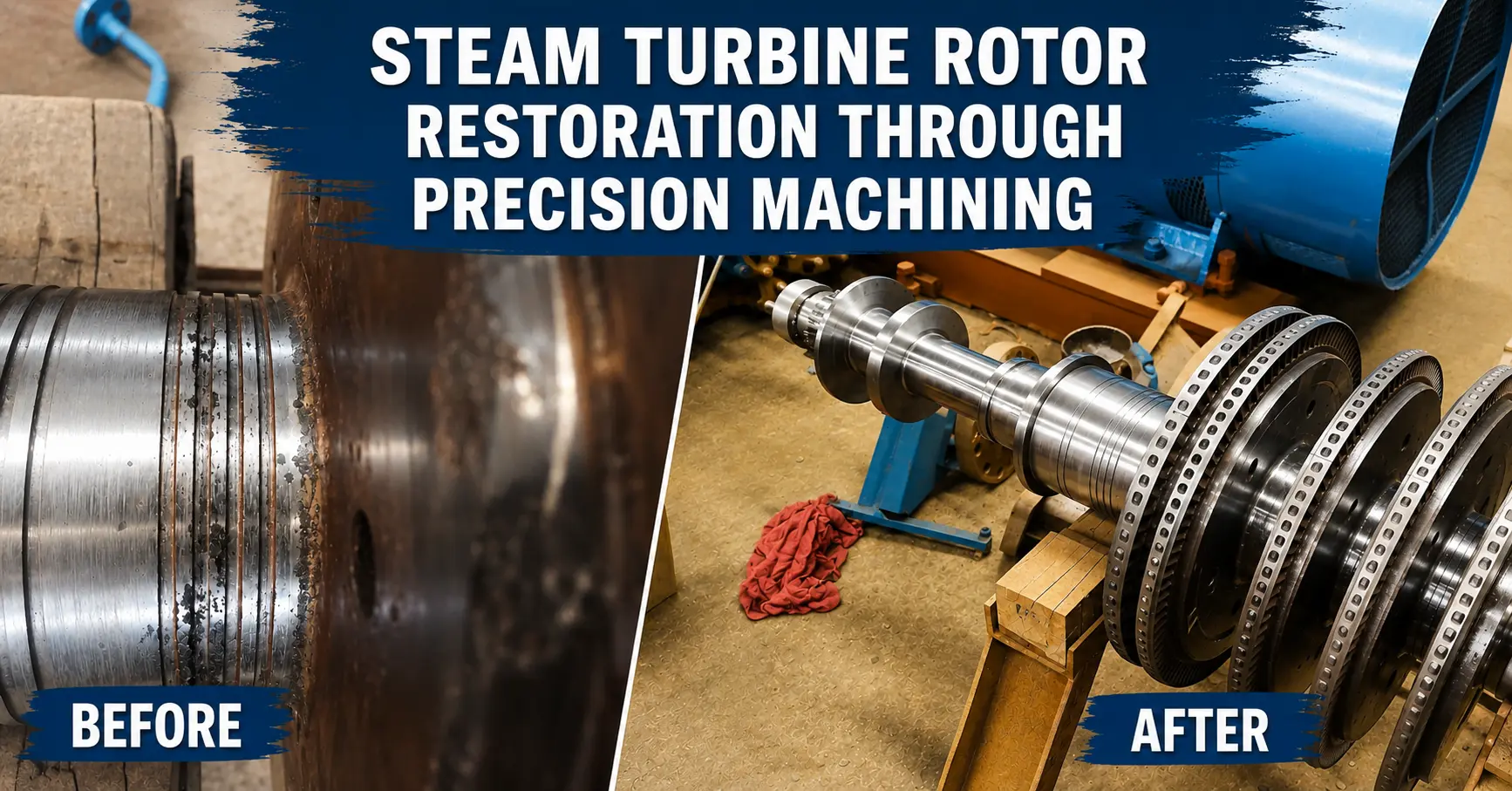
During a routine inspection, significant wear and surface damage were identified on the steam turbine rotor journal area. The damaged surface had deteriorated to a level where continued operation could potentially affect machine stability, efficiency, and reliability.
The traditional recommendation in such situations is usually complete rotor replacement. However, considering the high cost and operational impact involved, the team at NS Terbo evaluated an alternative solution focused on restoring the existing component.
The NS Terbo Engineering Approach
After a detailed technical assessment, NS Terbo team developed and implemented a precision machining restoration strategy designed to recover the rotor while maintaining operational integrity.
The restoration process included:
• Detailed inspection and analysis of the damaged area
• Precise measurement and dimensional assessment of the worn section
• Controlled machining of the damaged journal surface
• Approximately 1 mm undersize machining to eliminate surface defects
• Surface finishing and dimensional verification
• Final preparation for operational use
The machining operation was performed with strict attention to dimensional accuracy, alignment, and surface quality to ensure that the rotor could safely return to service.
Results Delivered by NS Terbo
The restoration process successfully brought the rotor back into operational condition without requiring complete replacement.
Significant Cost Savings
Replacing an entire steam turbine rotor requires major capital investment. By implementing a precision repair methodology, NS Terbo delivered a highly cost-effective solution while avoiding unnecessary expenditure.
Reduced Downtime
Manufacturing and procuring a new rotor typically involve extensive lead times. The restoration approach significantly reduced downtime and enabled faster machine availability.
Better Resource Utilization
Instead of discarding an entire component assembly, the existing rotor was effectively restored and reused, maximizing asset value.
Improved Maintenance Strategy
The successful execution of this project demonstrates how engineering expertise and precision machining can extend component life and support efficient maintenance practices.
Technical Outcome
Post-machining inspection showed improved surface finishing and restored geometry suitable for continued operation. The project proved that precision restoration can be a practical and reliable alternative when complete replacement is not economically justified.
Conclusion
Modern maintenance is no longer just about replacing damaged parts — it is about finding smarter, faster, and more economical engineering solutions.
This project executed by NS Terbo and its dedicated engineering team demonstrates how a damaged steam turbine rotor can be transformed into a serviceable asset through precision machining and technical expertise.
Rather than opting for a costly replacement, a targeted engineering approach successfully restored the component while reducing costs, minimizing downtime, and improving overall operational efficiency.
Because smart engineering is not about replacing everything — it is about restoring value where others see replacement.
"Engineering excellence is not measured by what you replace, but by what you successfully restore."