9/8/2026
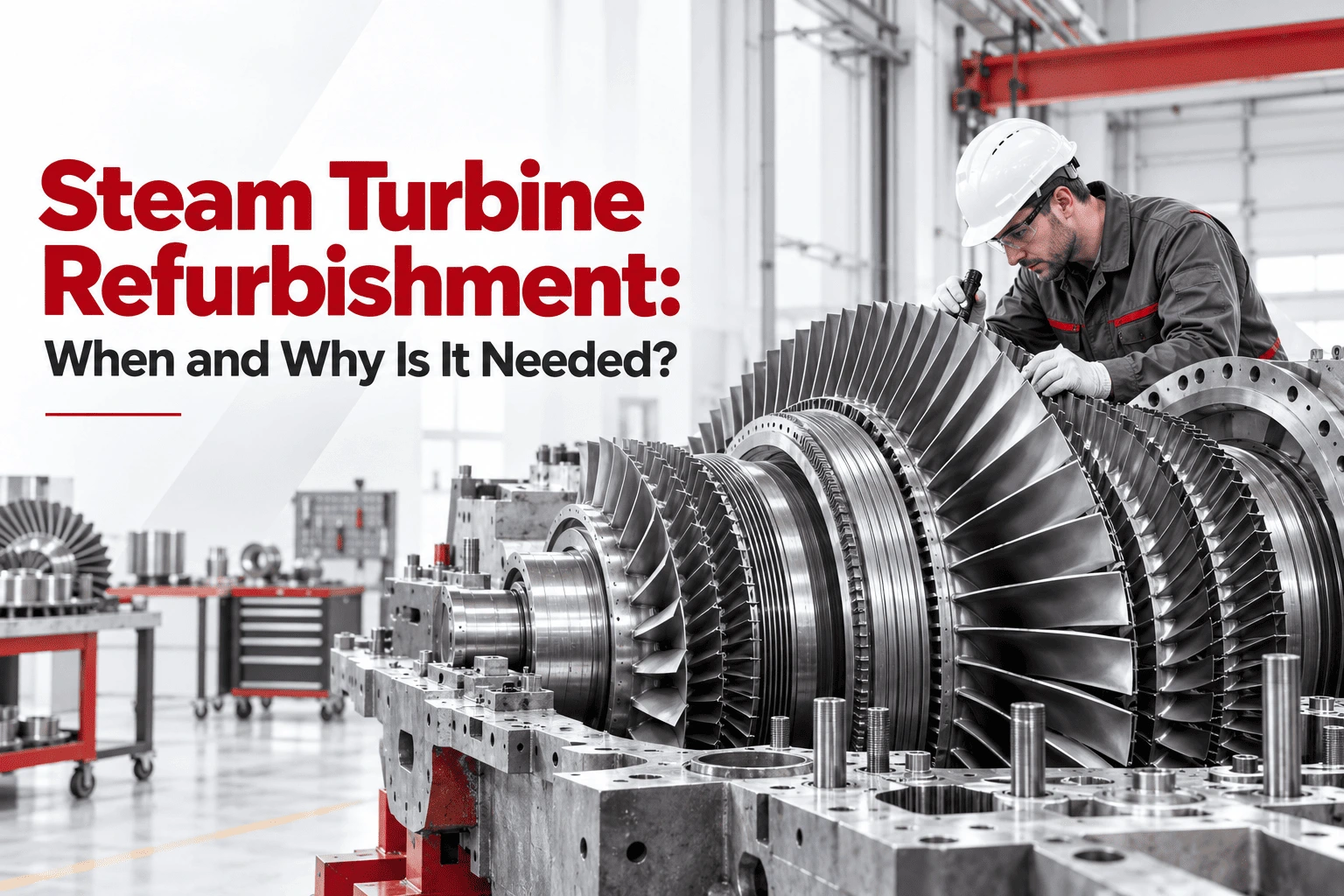
Steam Turbine Refurbishment: When and Why Is It Needed?
Learn when steam turbine refurbishment is needed, its benefits, warning signs, and how it restores efficiency, reliability, and turbine life.
Steam turbines operate continuously under high pressure, temperature and rotational speed. Over time, components can develop erosion, corrosion, seal deterioration, blade damage, bearing wear and rotor imbalance. These conditions can reduce turbine output, increase steam consumption and eventually cause an unexpected shutdown.
Steam turbine refurbishment is the process of inspecting, repairing, restoring and, where necessary, upgrading critical turbine components. It can recover lost performance, improve operational reliability and extend turbine service life without immediately replacing the complete turbine.
This guide explains the warning signs, benefits and major steps involved in refurbishing an industrial steam turbine.
What Is Steam Turbine Refurbishment?
Steam turbine refurbishment is a comprehensive engineering process used to restore an ageing, damaged or underperforming turbine. The work can include repairing reusable components, manufacturing replacement parts, correcting dimensional variations and restoring the turbine’s steam path.
Unlike routine steam turbine maintenance, refurbishment addresses accumulated mechanical wear and performance deterioration that ordinary servicing may not correct.
Depending on the turbine’s condition, the scope may include:
Turbine dismantling and inspection
Rotor runout and alignment checks
Blade and nozzle inspection
Rotor reblading
Journal and thrust bearing inspection
Labyrinth and carbon seal replacement
Shaft and coupling inspection
Dynamic rotor balancing
Control valve and governing-system servicing
Lube oil system inspection
Reverse engineering of obsolete components
Reassembly, alignment and commissioning
The final scope should always be based on inspection findings, operating data and the condition of individual components.
When Is Steam Turbine Refurbishment Needed?
There is no universal refurbishment interval for every turbine. The requirement depends on operating hours, turbine design, steam quality, load variations, maintenance history and the condition of critical components.
However, the following warning signs can indicate that steam turbine refurbishment is needed.
1. Declining Turbine Efficiency
A reduction in power output under similar steam conditions may indicate internal efficiency loss. Blade erosion, nozzle damage, deposits, excessive clearances and internal steam leakage can affect the turbine’s ability to convert steam energy into mechanical power.
Common symptoms include:
Reduced power output
Increased specific steam consumption
Higher steam requirement for the same load
Difficulty maintaining rated capacity
Poor response to changing operating loads
A performance assessment can help establish whether the problem is within the turbine or related to steam conditions and associated plant systems.
2. Excessive Turbine Vibration
High or unstable vibration can be caused by rotor imbalance, shaft misalignment, damaged blades, bearing wear, rotor bow or deposits on rotating components.
Continuing to operate with excessive vibration can damage seals, bearings, couplings and the turbine casing. Timely steam turbine troubleshooting is therefore essential before the problem develops into a serious mechanical failure.
3. Unusual Noise During Operation
Rubbing, scraping, knocking or other abnormal noises should not be ignored. These sounds may indicate internal contact, loose components, bearing problems or damaged turbine blades.
When unusual noise is accompanied by vibration, temperature changes or reduced performance, a detailed inspection should be planned as soon as operating conditions safely permit.
4. Blade Erosion or Damage
Turbine blades are exposed to high-velocity steam, moisture, contaminants and cyclic mechanical loads. These conditions may lead to:
Leading-edge erosion
Corrosion and pitting
Cracks or fractures
Surface deposits
Blade-root damage
Distortion of the blade profile
Damaged blades can reduce steam-path efficiency and create rotor imbalance. Depending on the severity of the damage, steam turbine blade repair, individual blade replacement or complete rotor reblading may be necessary.
5. Increased Bearing Temperature
A rise in journal or thrust bearing temperature can indicate inadequate lubrication, worn bearing surfaces, incorrect clearances, rotor misalignment or excessive thrust load.
During a steam turbine overhaul, engineers should inspect bearing clearances, contact patterns, oil condition, shaft journals and rotor alignment. Bearing problems require timely attention because they can affect rotor stability and damage the shaft.
6. Steam or Oil Leakage
Steam leakage around glands and seals reduces turbine efficiency and may create unsafe operating conditions. Oil leakage or unstable oil pressure can also compromise bearing lubrication and turbine reliability.
Worn labyrinth seals, carbon seals, gland components, gaskets and lube oil system parts may need to be repaired or replaced during refurbishment.
7. Repeated Breakdowns
Frequent bearing failures, recurring vibration or repeated emergency repairs may indicate a deeper mechanical or steam-path problem.
In such cases, a complete turbine condition assessment may provide better long-term results than repeatedly repairing individual symptoms. Planned industrial steam turbine servicing can identify the root cause and reduce the likelihood of another unexpected shutdown.
8. Ageing or Obsolete Components
Older turbines may remain mechanically serviceable even when original replacement components are no longer available. Obsolete drawings, discontinued parts and long procurement times can increase operational risk.
Reverse engineering can be used to develop compatible turbine blades, seals, bushes, bearings, couplings and other critical spares. This can support steam turbine life extension without replacing the entire turbine.
Why Is Steam Turbine Refurbishment Important?
Restores Turbine Performance
Worn seals, damaged blades, eroded nozzles and excessive clearances can reduce turbine performance. Correcting these issues may restore output and improve steam-path efficiency, subject to the turbine design and operating conditions.
Improves Energy Efficiency
A deteriorated turbine may require more steam to produce the same power output. Restoring steam-path components and controlling internal leakage can support steam turbine efficiency improvement and reduce specific steam consumption.
The actual improvement will depend on the turbine’s original design, component condition, steam parameters and operating load.
Reduces Unplanned Downtime
Unexpected turbine failure can interrupt production and result in substantial operational losses. A planned steam turbine refurbishment allows developing problems to be corrected during a scheduled shutdown.
It also enables the plant to arrange replacement components, technical resources and production schedules in advance.
Extends Turbine Service Life
Complete turbine replacement may not be required if its casing, foundation and major structural components remain serviceable. Refurbishment can extend the operating life of the existing machine by restoring reusable components and replacing parts that can no longer operate reliably.
Enhances Operational Reliability
Correct bearing clearances, accurate rotor alignment, balanced rotating components and restored seals contribute to stable turbine operation. Refurbishment also provides an opportunity to identify and correct the root causes of recurring problems.
Provides an Alternative to Complete Replacement
For many industrial plants, refurbishment can be more economical than purchasing and installing a new turbine. It may also reduce the need for extensive changes to foundations, piping and auxiliary systems.
Before making a decision, the plant should compare refurbishment cost, expected performance, remaining service life and the benefits of installing new equipment.
What Does the Steam Turbine Refurbishment Process Include?
A professional refurbishment project normally follows a structured process.
1. Review of Operating Data
Before dismantling the turbine, engineers review available information such as:
Turbine output and steam consumption
Inlet and exhaust steam parameters
Vibration trends
Bearing temperatures
Oil pressure and oil-analysis reports
Maintenance history
Previous inspection reports
Details of recurring breakdowns
This information helps identify potential problem areas before the turbine is opened.
2. Turbine Dismantling and Inspection
The turbine is carefully dismantled, and the condition of each major component is documented. The inspection may reveal erosion, deposits, cracks, rubbing marks, leakage paths and abnormal wear.
3. Dimensional Inspection and Testing
Critical turbine components are measured and tested to assess their mechanical and structural condition. Depending on the application, the inspection may include:
Dye penetrant testing
Magnetic particle testing
Ultrasonic testing
Hardness testing
Shaft runout measurement
Blade-clearance inspection
Seal-clearance inspection
Bearing-clearance measurement
The findings are used to prepare the final repair and replacement recommendations.
4. Steam Turbine Rotor Refurbishment
Steam turbine rotor refurbishment may include cleaning, runout correction, shaft-journal restoration, blade replacement, coupling inspection and dynamic balancing.
As the rotor is one of the turbine’s most critical components, every repair decision must consider its material condition, operating stresses and engineering requirements.
5. Blade, Nozzle and Seal Restoration
Damaged blades and nozzles may require restoration or replacement. Labyrinth seals, carbon seals and gland components are inspected for wear and restored to the specified clearances.
Correct steam-path geometry is important for controlling leakage and achieving stable turbine performance.
6. Bearing and Lubrication-System Inspection
Journal bearings, thrust bearings, oil pumps, filters, coolers and oil pipelines are inspected. Worn bearing surfaces and unreliable lubrication components are repaired or replaced as required.
7. Reassembly and Alignment
After completing the approved repairs, the turbine is reassembled. Rotor alignment, bearing position, coupling alignment and internal clearances are checked before commissioning.
8. Testing and Commissioning
The refurbished turbine is gradually returned to operation while engineers monitor:
Turbine vibration
Bearing temperature
Oil pressure
Speed stability
Steam leakage
Load response
Power output
Post-refurbishment observations should be compared with previous operating data and the agreed performance targets.
Steam Turbine Refurbishment vs Steam Turbine Overhaul
A routine steam turbine overhaul generally includes scheduled inspection, cleaning, adjustment and replacement of normal wear components.
Steam turbine refurbishment is a more extensive process. It may involve restoring or remanufacturing major components, correcting rotor problems, replacing damaged blades and recovering lost turbine performance.
Refurbishment may be considered when:
Blades or nozzles are seriously damaged
The rotor requires extensive restoration
Critical spare parts are obsolete
Turbine efficiency has declined
Routine maintenance has not resolved recurring problems
The plant needs to extend the turbine’s service life
The final decision should be based on inspection results, operational requirements, safety considerations and commercial evaluation.
How to Plan a Successful Turbine Refurbishment
Effective planning can reduce shutdown duration and prevent avoidable delays. Plant operators should:
Maintain accurate operating and maintenance records
Monitor vibration and turbine performance
Plan the shutdown schedule in advance
Identify long-lead replacement components
Provide available turbine drawings and specifications
Conduct a complete condition assessment
Approve repair procedures before execution
Establish testing and inspection checkpoints
Record final clearances and balancing results
Monitor the turbine closely after commissioning
A refurbishment provider should have experience in turbine inspection, rotor work, reverse engineering, blade replacement, precision balancing and commissioning.
Steam Turbine Refurbishment Services by NS Terbo
NS Terbo provides engineering, inspection, repair and refurbishment support for industrial steam turbines. Each project is planned according to the turbine’s design, operating history and actual component condition.
Our services include:
Steam turbine overhauling and troubleshooting
Rotor inspection and refurbishment
Rotor reblading and blade replacement
Journal and thrust bearing support
Labyrinth and carbon seal replacement
Rotor runout checking and balancing
Reverse engineering of turbine components
Coupling and lube oil system inspection
Erection and commissioning assistance
Supply of steam turbine spares
Each project begins with a technical assessment to identify which components can be restored and which should be replaced.
Conclusion
Steam turbine refurbishment may be required when a turbine experiences efficiency loss, excessive vibration, bearing problems, seal leakage, blade damage or recurring failures. It can also support plants operating older turbines for which original spare parts are difficult to obtain.
A properly planned refurbishment can restore turbine performance, reduce unplanned downtime, improve reliability and extend service life. The final scope should always be based on operating data, detailed inspection and sound engineering evaluation.
If your steam turbine is experiencing performance deterioration or repeated maintenance problems, contact NS Terbo for a technical assessment and an appropriate repair, overhaul or refurbishment plan.
Discuss Your Steam Turbine Refurbishment Requirements
Website: https://nsterbo.com/
Contact: +91 95175 66235
FAQs:
What is steam turbine refurbishment?
Steam turbine refurbishment is the process of inspecting, repairing and restoring critical turbine components to recover performance, improve reliability and extend the equipment’s operating life.
When should a steam turbine be refurbished?
Refurbishment should be considered when a turbine develops declining output, excessive vibration, abnormal noise, damaged blades, seal leakage, high bearing temperatures or repeated breakdowns.
What is the difference between turbine refurbishment and overhaul?
An overhaul usually covers scheduled inspection, cleaning and replacement of routine wear parts. Refurbishment involves more extensive restoration of components such as the rotor, blades, nozzles, bearings and seals.
Can refurbishment improve steam turbine efficiency?
Yes. Restoring damaged steam-path components, reducing internal leakage and correcting excessive clearances may improve turbine efficiency. Actual results depend on the turbine’s design and condition.
Can an old steam turbine be refurbished?
An older turbine may be refurbished if its major structural components remain serviceable. Inspection and engineering evaluation are required to determine whether refurbishment is technically and commercially suitable.