5/18/2026
Restored Today. Failed Tomorrow. The Reality of Spray Laser Cladding
Spray laser cladding may restore shafts temporarily, but layer failure risks shutdowns, damage, and safety hazards in critical rotating equipment.
In heavy industries, rotating shafts are the backbone of machines like turbines, rollers, pumps, compressors, and gear systems. These shafts continuously rotate under high load, pressure, vibration, and friction. Over time, this causes severe wear on the shaft surface.
Even a small reduction in diameter can create serious problems:
Improper fitting
Excess vibration
Bearing damage
Misalignment
Machine failure
Production downtime
To restore the damaged area, industries often use Spray Laser Cladding.
What Happens in Spray Laser Cladding?
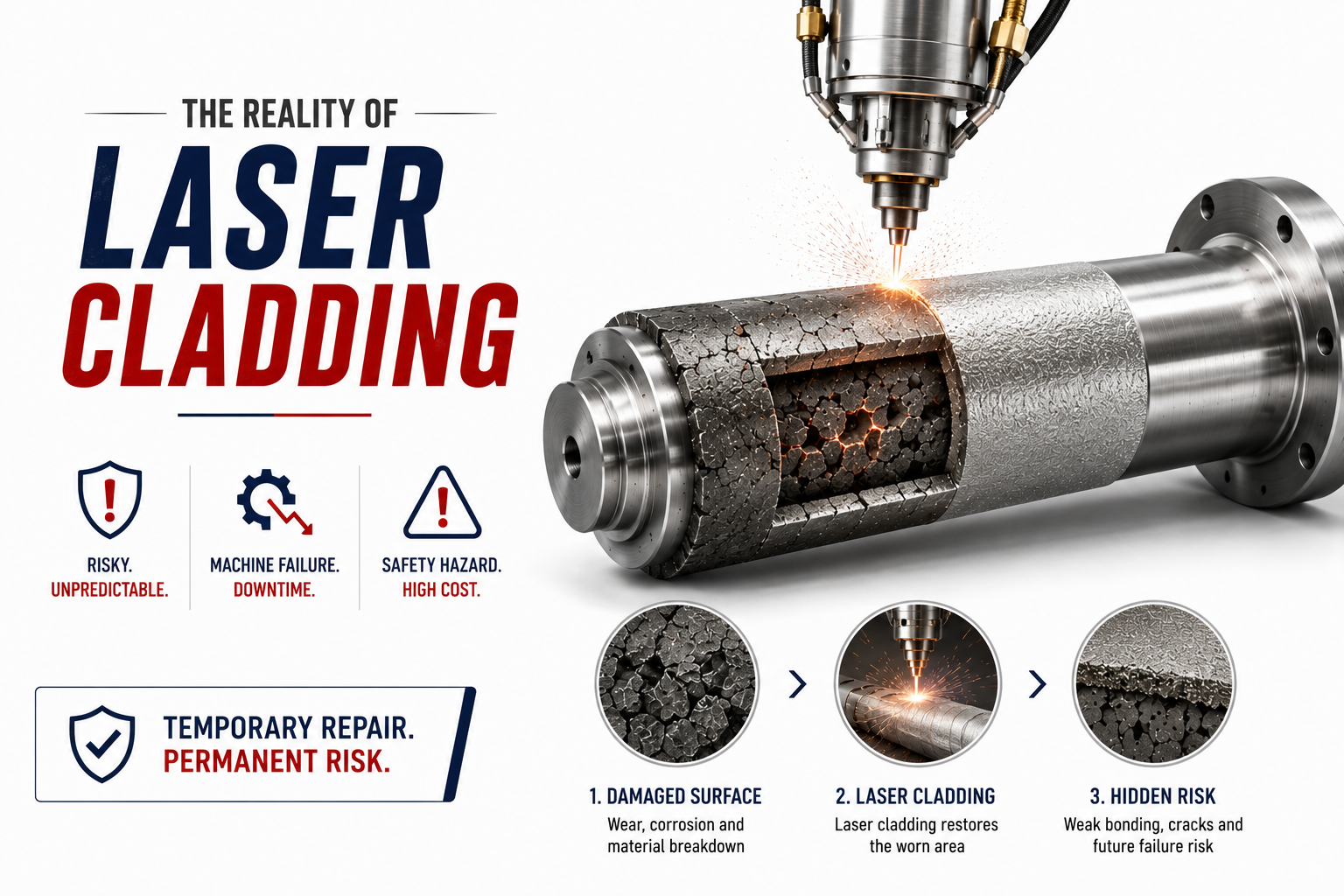
In Spray Laser Cladding, a special metal powder is sprayed and fused onto the worn shaft surface using a high-energy laser beam.
This process adds an extra material layer over the damaged area.
After cladding, the shaft is sent for precision grinding and machining.
The grinding process removes the excess material and brings the shaft back to its original dimension
At this stage, the shaft looks completely restored and ready for operation.
The Real Industry Challenge
Although Spray Laser Cladding restores dimensions, the major concern begins after the machine starts running again.
Under continuous rotation, heavy load, thermal stress, and vibration:
The clad layer may start weakening
Bonding can fail over time
Surface cracking may occur
Layer peeling or detachment can happen
If the clad layer comes out during operation, the consequences can be extremely dangerous.
Risks of Cladding Layer Failure
A failed shaft repair can lead to:
Sudden Plant Shutdown
If the shaft fails during operation, the entire production line may stop instantly.
Heavy Financial Loss
Unplanned downtime can cost industries lakhs or even crores in lost production.
Safety Hazards & Accidents
A damaged rotating shaft can create serious safety risks for operators and nearby equipment.
Damage to Bearings & Couplings
Layer failure can affect connected machine components and increase maintenance costs.
Why Spray Laser Cladding Can Become a Serious Risk Over Time
Spray Laser Cladding may temporarily restore a worn shaft, but in critical rotating equipment, it can become a risky and dangerous repair solution. Under continuous load and vibration, the clad layer may crack or suddenly peel off, leading to severe machine failure and plant shutdowns.
And when it fails, the damage can be catastrophic:
Sudden Shaft Failure
Complete Plant Shutdown
Bearing & Coupling Damage
Massive Production Losses
Emergency Maintenance Costs
Serious Industrial Safety Risks
In high-speed rotating equipment, even a minor clad layer failure can destroy the entire system within seconds.
Why Shaft Replacement Is Often the Better Solution
For critical industrial applications, complete shaft replacement is the safest and most reliable solution for long-term performance, operational stability, and uninterrupted plant safety.
A new shaft provides:
Original material strength
Better operational reliability
Higher safety during continuous operation
Reduced risk of sudden failure
Longer service life
Lower chances of emergency shutdowns
Final Thoughts
Spray Laser Cladding may offer a quick temporary repair, but in critical rotating equipment, it can become a serious operational risk.
Under heavy load and continuous rotation, the clad layer can crack or peel off without warning — leading to sudden shaft failure, plant shutdowns, equipment damage, production losses, and major safety hazards.
Complete shaft replacement remains the safer, stronger, and more reliable long-term solution for uninterrupted and secure plant operation.