9/14/2026
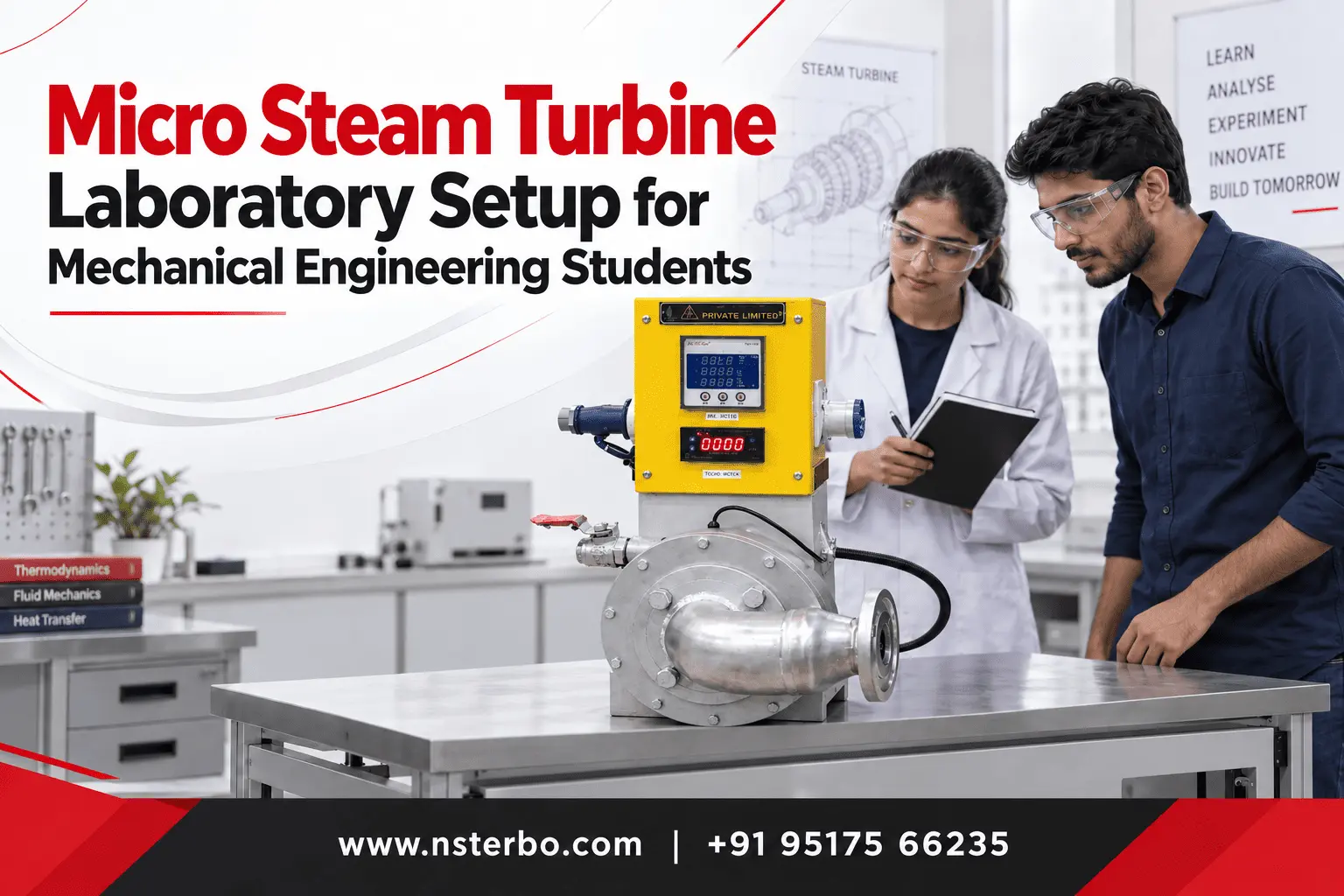
Micro Steam Turbine Laboratory Setup for Mechanical Engineering Students
Explore how a Micro Steam Turbine Laboratory Setup helps mechanical engineering students study turbine working, performance, efficiency and energy conversion.
Engineering education becomes more meaningful when students can observe, operate and evaluate the systems they study in textbooks. Thermodynamics and power plant engineering involve several concepts that are difficult to understand through theory alone. A Micro Steam Turbine Laboratory Setup gives mechanical engineering students a controlled platform for studying how steam energy is converted into useful mechanical power.
Through practical operation, students can observe changes in pressure, temperature, speed, load and steam flow. They can also record readings, perform calculations and compare actual results with theoretical principles. This makes the setup a valuable addition to thermal engineering and power plant laboratories in engineering colleges, universities and technical training institutes.
What Is a Micro Steam Turbine Laboratory Setup?
A Micro Steam Turbine Laboratory Setup is a compact educational system developed to demonstrate the working and performance of a steam turbine. It normally combines a small steam turbine with measuring instruments, controls, a loading arrangement and safety provisions required for laboratory experiments.
Unlike a classroom model that only displays turbine components, an operational setup allows students to observe an actual energy-conversion process. Steam enters the turbine under controlled conditions and transfers energy to the rotor. The rotating shaft can then drive a suitable load or demonstration device. Instruments installed on the system help students measure the parameters required for performance analysis.
The configuration of an Educational Steam Turbine Test Rig may vary according to the curriculum, laboratory infrastructure and learning objectives of the institution.
Why Mechanical Engineering Students Need Practical Turbine Training
Students study steam properties, thermodynamic cycles, fluid flow and turbine performance during their mechanical engineering programme. However, equations alone may not explain how operating conditions influence an actual machine.
A Steam Turbine Training System helps students connect theoretical concepts with observable results. For example, they can examine how a change in steam supply or applied load affects turbine speed and output. They can also learn why stable operating conditions, correct measurements and systematic data recording are important.
Practical turbine training supports:
Better understanding of steam-energy conversion
Familiarity with turbine components and controls
Development of observation and analytical skills
Practice in recording and interpreting experimental data
Awareness of operating procedures and laboratory safety
Preparation for careers in thermal, energy and power-related industries
Working Principle of a Micro Steam Turbine
A micro steam turbine works by converting the thermal and pressure energy of steam into rotational mechanical energy. Steam is supplied to the turbine through a regulated inlet. As it passes through the steam path, its energy produces a force on the rotor blades or turbine wheel. This force rotates the shaft.
The rotating shaft is connected to a loading or power-measurement arrangement. Students can vary operating conditions within the specified range and note the corresponding changes in turbine behaviour. Pressure, temperature, speed, flow and load readings may be used to calculate parameters such as steam consumption, shaft output and efficiency.
The exact steam path, turbine construction and measuring arrangement depend on the design selected by the institution. All experiments should be performed according to the equipment manufacturer's operating manual and under qualified laboratory supervision.
Main Components of the Laboratory Setup
A properly designed Micro Steam Turbine Laboratory Setup may include the following components:
1. Micro Steam Turbine
The turbine is the main unit in which steam energy is converted into shaft rotation. Its compact construction makes it suitable for supervised educational use and demonstration.
2. Steam Supply and Control Arrangement
This section delivers steam to the turbine at controlled conditions. Suitable valves and controls help regulate the steam supply during an experiment.
3. Loading Arrangement
A loading device applies a measurable load to the turbine shaft. It enables students to study performance under different operating conditions.
4. Measurement Instruments
Depending on the selected configuration, the system may include instruments for measuring pressure, temperature, rotational speed, steam flow and load. Digital indicators or a data-acquisition facility may also be incorporated.
5. Control and Instrumentation Panel
The control panel brings important indications and controls together in an accessible location. Clear instrument identification makes the experiment easier to conduct and understand.
6. Base Frame and Safety Provisions
The turbine, instrumentation and associated components are mounted on a stable frame. Guards, insulation, pressure-rated components and emergency controls should be selected according to the applicable design and safety requirements.
Experiments Students Can Perform
The experiments available depend on the turbine model, instrumentation and institutional syllabus. A suitable Micro Steam Turbine for Engineering Colleges can support activities such as:
Studying the construction and working principle of a steam turbine
Recording turbine speed at different operating conditions
Observing the relationship between applied load and shaft speed
Measuring steam pressure and temperature
Determining steam consumption under specified conditions
Estimating shaft power or mechanical output
Calculating turbine efficiency using measured values
Plotting performance characteristic curves
Comparing experimental observations with theoretical calculations
Understanding start-up, controlled operation and shutdown procedures
These experiments encourage students to do more than follow a fixed procedure. They learn to evaluate readings, identify possible measurement errors and explain why practical results may differ from ideal calculations.
Educational Benefits of the Setup
Converts Theory into Visible Learning
Students can directly observe a process that is otherwise explained through diagrams and equations. This improves conceptual understanding and retention.
Develops Instrumentation Skills
The setup introduces students to industrially relevant parameters such as pressure, temperature, speed, flow and load. They learn how readings are collected and used for engineering calculations.
Supports Performance Analysis
Students can prepare observation tables, calculate results and draw characteristic curves. This develops analytical ability and technical-report-writing skills.
Encourages Team-Based Learning
Laboratory experiments require students to coordinate operating, observing, recording and calculating tasks. This supports teamwork and disciplined experimental practice.
Improves Industry Readiness
Exposure to rotating equipment, operating controls and performance measurements gives students a stronger foundation for future training and industrial roles.
How to Select a Steam Turbine Training System
Engineering institutions should evaluate a laboratory system according to teaching requirements rather than selecting it only by turbine size. Important factors include:
Curriculum Compatibility
The available experiments should support the subjects and learning outcomes defined by the mechanical, thermal or energy engineering syllabus.
Clearly Measurable Parameters
The system should provide the instruments required for meaningful calculations. Instrument ranges, resolution and identification should be suitable for student experiments.
Safe and Convenient Operation
The layout should allow supervised operation, clear access to controls and safe observation. Operating instructions and safety procedures must be provided and followed.
Space and Utility Requirements
Institutions should review the required steam source, water arrangement, electrical supply, ventilation, drainage and available laboratory space before installation.
Data Acquisition Options
Where the curriculum requires detailed analysis, institutions may consider a system with digital measurement, data logging or computer-based performance monitoring.
Documentation and Training
A useful educational system should be supported by an operating manual, experiment procedures, technical documentation and faculty or laboratory-staff training.
Service and Spare Support
Long-term technical assistance and the availability of suitable spare parts are important for maintaining laboratory continuity.
Role in Thermal and Power Plant Engineering Education
A micro turbine setup can strengthen courses related to thermodynamics, thermal engineering, fluid mechanics, energy conversion and power plant engineering. It provides a common practical platform through which several classroom concepts can be demonstrated.
It may also support student projects involving performance comparison, operating-data analysis, instrumentation or efficiency studies. When equipped with suitable data-recording features, the setup can help students prepare project reports based on actual experimental observations.
As a piece of Mechanical Engineering Laboratory Equipment, its educational value lies not merely in showing a rotating turbine but in enabling repeatable measurement, calculation and interpretation.
Importance of Safety and Supervision
Steam systems involve pressure, temperature and rotating components. Therefore, a laboratory turbine must be operated only by trained personnel or students working under qualified supervision.
Before each experiment, users should inspect the steam connections, valves, guards, instruments and operating area. The system must be operated only within the limits specified by its manufacturer. Personal protective equipment and institutional laboratory-safety procedures should always be followed.
Safe operation itself is an important engineering lesson. It helps students understand that equipment performance and responsible operating practices must always work together.
Why Institutions Should Invest in Practical Training Equipment
Modern engineering programmes are expected to develop both conceptual knowledge and practical competence. A Micro Steam Turbine Laboratory Setup can help an institution create an engaging learning environment in which students work with real operating parameters rather than relying only on simulations or static models.
The setup can be used for regular laboratory classes, faculty demonstrations, student projects and technical training. A thoughtfully selected system can therefore support multiple academic activities over its service life.
NS Terbo can develop micro steam turbine training solutions according to an institution's laboratory objectives, available utilities and desired instrumentation. The final configuration should be selected after a detailed technical discussion to ensure alignment with the curriculum and facility requirements.
Conclusion
A Micro Steam Turbine Laboratory Setup provides mechanical engineering students with a practical way to understand steam-turbine operation, energy conversion, performance measurement and safe equipment handling. By linking theoretical principles with measured results, it strengthens learning in thermal and power plant engineering.
For engineering colleges and universities, the right setup should offer relevant experiments, clear instrumentation, safe operation, reliable documentation and appropriate technical support. Such an investment helps students develop the practical insight and analytical skills required for their future engineering careers.
Frequently Asked Questions
1. What is a Micro Steam Turbine Laboratory Setup?
A Micro Steam Turbine Laboratory Setup is an educational system that allows students to study steam-energy conversion, turbine operation and performance parameters through controlled practical experiments.
2. Why is a micro steam turbine useful for mechanical engineering students?
It helps students connect thermodynamics and power plant engineering theory with practical observations. They can measure operating parameters, analyse turbine performance and understand equipment controls.
3. Which experiments can be performed using a micro steam turbine setup?
Depending on its configuration, students may study turbine working, speed-load characteristics, steam consumption, mechanical output, efficiency and performance curves.
4. What instruments are included in a steam turbine training system?
A typical system may include pressure and temperature indicators, speed measurement, flow measurement, a loading arrangement and a control panel. Digital data acquisition can be added where required.
5. Which departments can use this laboratory setup?
The setup is suitable for Mechanical Engineering, Thermal Engineering, Energy Engineering and Power Plant Engineering departments in colleges, universities and technical training institutions.