5/19/2026
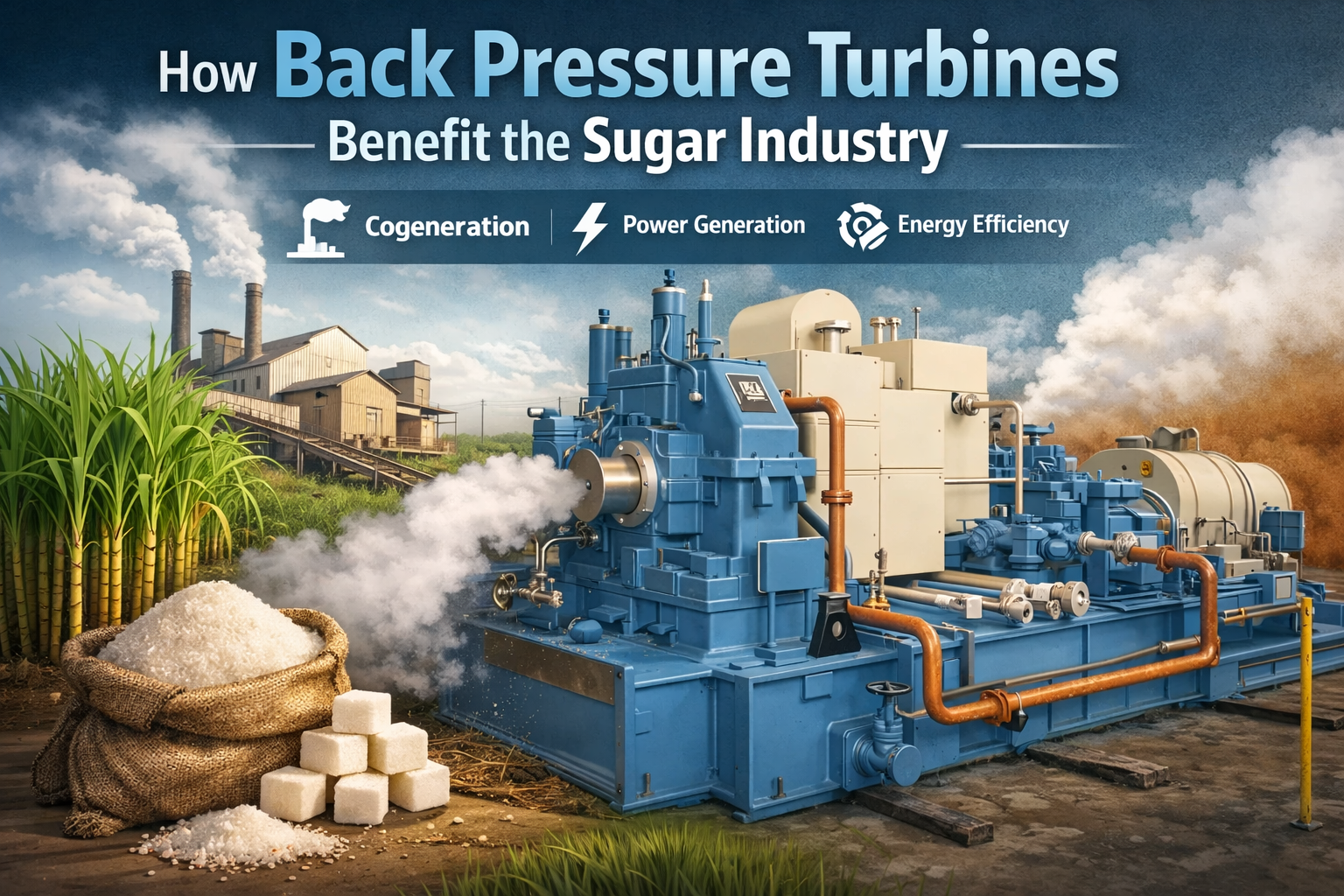
How Back Pressure Turbines Benefit the Sugar Industry
Discover how back pressure steam turbines improve energy efficiency, reduce costs, and enable cogeneration in sugar mills by maximizing bagasse-based power gene
In today’s competitive sugar market, profitability depends not only on sugar recovery but also on how efficiently a plant uses its energy. This is where back pressure steam turbines become a game-changing solution.
In most sugar factories, steam is already available from bagasse-fired boilers. Instead of wasting this high-pressure steam, a back pressure turbine converts it into electricity first — and then releases the exhaust steam at usable pressure for process heating. The result? Maximum energy utilization with minimum fuel wastage.
Also Read: Turbine Rotor: The Heart of High-Performance Industrial Systems
What Is a Back Pressure Turbine?
A back pressure turbine is a type of steam turbine that produces power and discharges steam at a controlled pressure suitable for industrial processes.
Unlike condensing turbines that release steam into a condenser, back pressure turbines supply exhaust steam directly to operations like:
Juice heating
Evaporation
Crystallization
Pan boiling
This makes them ideal for industries like sugar manufacturing where both power and process steam are continuously required.
Why the Sugar Industry Needs It
Sugar mills generate large amounts of steam from bagasse (a byproduct of sugarcane). Instead of using this steam only for heating, back pressure turbines enable cogeneration — simultaneous production of electricity and thermal energy.
This improves:
Energy efficiency
Fuel utilization
Cost control
Operational sustainability
1️ Maximizes Energy from Bagasse
Bagasse is a free fuel generated within the plant. By installing a back pressure turbine, mills can:
✔ Generate their own electricity
✔ Reduce dependence on grid power
✔ Export surplus electricity (in some cases)
This turns a by product into a revenue-generating resource.
2️ Reduces Operational Costs
Electricity is one of the largest expenses in sugar processing. Generating captive power through back pressure turbines significantly lowers:
Power purchase costs
Transmission losses
Dependency on unstable grid supply
Over time, this leads to strong ROI and improved plant profitability.
3️ Enhances Process Efficiency
The exhaust steam from the turbine is not wasted. It is used directly in critical process stages such as evaporation and crystallization.
This ensures:
Stable steam pressure
Better temperature control
Improved sugar recovery
The plant operates more smoothly with optimized thermal balance.
4️ Enables Cogeneration Advantage
Cogeneration is highly effective in sugar mills because steam demand and power demand run parallel during crushing season.
Back pressure turbines make cogeneration practical by:
Producing electricity first
Supplying process steam afterward
Maintaining energy balance throughout operations
This dual utilization increases overall plant efficiency up to 70–80% compared to separate power generation.
5️ Supports Sustainable & Green Energy
With growing environmental regulations, industries must reduce carbon emissions. Since sugar mills use renewable bagasse as fuel, back pressure turbines help:
Lower fossil fuel consumption
Reduce carbon footprint
Improve environmental compliance
This strengthens the plant’s sustainability profile.
6️ Reliable & Low Maintenance
Back pressure turbines are:
Mechanically robust
Simple in design
Long-lasting
Suitable for continuous operation
For seasonal industries like sugar, reliability during peak crushing season is critical — and these turbines deliver consistent performance.
Also Read: Why Skilled Riveting Still Matters in Turbine Blade Assembly
The Bottom Line
Back pressure turbines are not just power-generating equipment — they are strategic assets for sugar factories.
They help mills:
Convert waste into energy
Cut electricity costs
Improve process stability
Enhance sustainability
Increase overall profitability
In an industry where margins are tight and efficiency is everything, investing in back pressure turbine technology is not an option — it’s a necessity.