9/4/2026
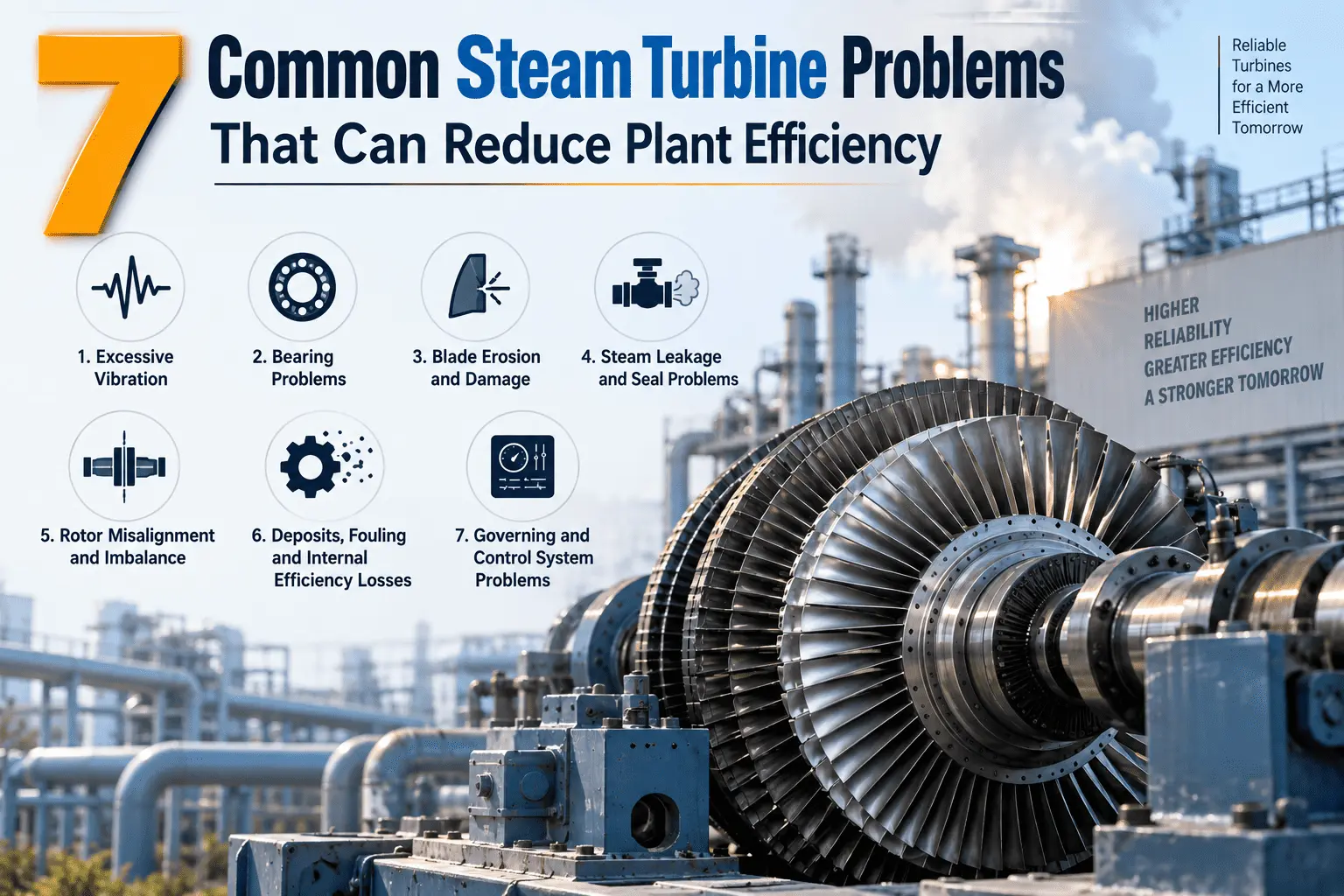
7 Common Steam Turbine Problems That Can Reduce Plant Efficiency
Discover 7 common steam turbine problems, their causes, efficiency impact, troubleshooting methods, and maintenance solutions for reliable operation.
Steam turbines play a critical role in power generation and industrial processes, converting steam energy into mechanical power with high reliability and efficiency. However, continuous operation, changing load conditions, steam quality, wear, and inadequate maintenance can gradually affect turbine performance.
Identifying steam turbine problems at an early stage is essential because even relatively small mechanical or operational issues can contribute to efficiency loss, increased vibration, higher maintenance requirements, unplanned shutdowns, and reduced equipment life.
For plant operators and maintenance teams, understanding common steam turbine performance issues can help improve troubleshooting, maintenance planning, and overall equipment reliability.
This guide discusses seven common steam turbine problems, their possible causes, their impact on plant efficiency, and the maintenance practices used to address them.
1. Excessive Steam Turbine Vibration
Excessive vibration is one of the most important warning signs requiring attention during steam turbine operation. A sudden increase or gradual change in vibration levels can indicate developing mechanical problems.
Common causes of steam turbine vibration problems include:
Rotor imbalance
Shaft or coupling misalignment
Bearing wear or damage
Mechanical looseness
Blade damage
Rotor bow
Uneven deposits on rotating components
Changes in operating conditions
High vibration should not be considered only a mechanical inconvenience. If the underlying cause remains unresolved, it may increase stress on bearings, seals, couplings, blades, and other rotating components.
How to Address It
Plant maintenance teams should monitor vibration trends rather than relying only on a single measurement. Depending on the findings, troubleshooting may involve checking alignment, bearing condition, rotor runout, balance condition, clearances, and rotating components.
Detailed vibration analysis can help identify the likely source before corrective maintenance is planned.
2. Steam Turbine Bearing Problems
Bearings support the turbine rotor and help maintain stable shaft rotation and alignment. Their condition directly influences the reliability of the rotating assembly.
Common steam turbine bearing problems can include:
Bearing surface wear
Lubrication problems
Excessive bearing clearance
High bearing temperature
Oil contamination
Inadequate oil pressure or flow
Thrust bearing deterioration
Bearing problems may produce symptoms such as increased vibration, unusual temperature trends, abnormal noise, or changes in shaft position.
Why Bearings Affect Turbine Efficiency
A deteriorating bearing condition can affect rotor stability and alignment. In severe cases, it may also increase the risk of contact between rotating and stationary components.
Routine monitoring of bearing temperatures, vibration, oil pressure, oil condition, and shaft behaviour can help detect abnormalities before they develop into more serious failures.
3. Steam Turbine Blade Erosion and Damage
Steam turbine blades continuously interact with high-velocity steam. Their profile and surface condition are important for efficient energy transfer.
Over time, blades may experience:
Erosion
Corrosion
Deposits
Cracking
Surface deterioration
Mechanical damage
Foreign-object damage
Steam turbine blade damage can alter the aerodynamic profile of the blades and reduce the effectiveness of steam energy conversion.
Effect on Steam Turbine Performance
When blade surfaces become damaged, eroded, or heavily contaminated, steam flow may no longer follow the intended aerodynamic path. This can contribute to reduced stage performance and overall steam turbine efficiency loss.
During planned inspections, turbine blades should therefore be examined for deposits, erosion, cracks, surface damage, and other abnormalities. Appropriate repair, cleaning, refurbishment, or replacement should be determined based on inspection results and engineering assessment.
4. Steam Leakage and Seal Problems
Steam leakage is another common source of turbine performance loss.
Steam turbines use sealing arrangements such as labyrinth seals and other sealing components to control leakage between different pressure zones and around the shaft.
As seals and internal components wear, clearances may increase.
Common causes of steam turbine seal leakage include:
Seal wear
Excessive internal clearance
Damaged labyrinth components
Rotor-to-seal alignment issues
Thermal distortion
Mechanical damage
How Steam Leakage Reduces Efficiency
Steam that bypasses its intended flow path may not contribute effectively to useful energy conversion. Excessive internal leakage can therefore reduce stage efficiency and overall turbine performance.
During turbine maintenance or overhauling, seal condition and critical clearances should be carefully inspected and compared with applicable specifications.
5. Rotor Misalignment and Imbalance
The rotor is one of the most critical components of a steam turbine. Proper alignment and balance are necessary for smooth and reliable operation.
Steam turbine rotor problems can develop due to:
Improper alignment
Uneven deposits
Blade damage
Coupling problems
Rotor distortion
Bearing deterioration
Changes following maintenance or component replacement
Rotor imbalance frequently manifests as increased vibration. Misalignment may also influence bearing loading, coupling behaviour, and seal clearances.
Corrective Measures
Depending on the diagnosis, corrective work may include:
Alignment checks
Rotor runout inspection
Coupling inspection
Bearing inspection
Rotor balancing
Blade inspection
Clearance verification
Accurate diagnosis is important because vibration symptoms can have several possible causes.
6. Deposits, Fouling and Internal Efficiency Losses
Steam quality and operating conditions can influence deposit formation on internal turbine components.
Deposits may accumulate on:
Turbine blades
Nozzles
Steam passages
Sealing areas
Other internal surfaces
Fouling can modify steam-flow passages and affect aerodynamic performance.
What Causes Steam Turbine Efficiency Loss?
Deposits and fouling are only some of the possible causes. Steam turbine efficiency loss may also result from:
Blade erosion
Excessive internal clearances
Steam leakage
Seal deterioration
Poor steam conditions
Operating away from design conditions
Mechanical deterioration
Tracking performance parameters over time can help plant teams identify gradual deterioration that may otherwise go unnoticed.
7. Governing and Control System Problems
A steam turbine must respond accurately to changing operating requirements. Governing and control systems regulate steam admission and help maintain the required speed, load, and operating conditions.
Potential issues may involve:
Control valve problems
Governor malfunction
Actuator issues
Valve sticking
Instrumentation problems
Incorrect calibration
Slow or unstable control response
These problems can affect turbine stability and its ability to operate efficiently at the required load.
Why Control-System Maintenance Matters
Mechanical components may be in acceptable condition while the turbine still performs poorly because of control or valve-related issues.
For this reason, effective steam turbine troubleshooting should consider both mechanical condition and the turbine's governing and control system.
How to Improve Steam Turbine Efficiency
Improving turbine efficiency is not usually achieved through one maintenance action. It requires a systematic approach combining operating data, condition monitoring, inspection, and planned maintenance.
Important practices include:
Monitor vibration trends
Check bearing temperatures and lubrication conditions
Maintain appropriate steam conditions
Inspect turbine blades and nozzles
Check seals and critical clearances
Monitor steam leakage
Verify shaft and coupling alignment
Inspect rotor condition
Maintain governing and control systems
Carry out planned steam turbine maintenance and overhauling
A condition-based maintenance strategy can help identify deterioration earlier and allow maintenance to be planned before performance problems become major failures.
Importance of Preventive Steam Turbine Maintenance
Effective steam turbine maintenance is not limited to repairing a turbine after a failure occurs.
Preventive and condition-based maintenance can help plant operators identify developing issues, understand performance deterioration, and plan corrective work during scheduled shutdowns.
A typical maintenance program may include inspection of:
Rotor and shaft
Turbine blades
Nozzles
Journal and thrust bearings
Labyrinth and other seals
Couplings
Lubrication system
Governing components
Control valves
Critical internal clearances
The exact scope should always depend on turbine design, operating history, inspection results, manufacturer recommendations, and plant requirements.
Steam Turbine Troubleshooting: Why Accurate Diagnosis Matters
Many common steam turbine problems produce similar symptoms.
For example, excessive vibration could originate from imbalance, misalignment, bearing condition, mechanical looseness, rotor issues, or blade-related problems. Likewise, reduced turbine output may result from steam conditions, deposits, leakage, increased clearances, blade deterioration, or control-system performance.
Replacing components without identifying the underlying cause may therefore fail to resolve the problem.
Effective steam turbine troubleshooting should combine operating data with physical inspection and appropriate diagnostic measurements.
Steam Turbine Maintenance & Overhauling Support from NS Terbo
At NS Terbo Pvt. Ltd., we support industrial plants with steam turbine maintenance, inspection, troubleshooting, refurbishment, spares, and overhauling solutions.
Our steam turbine service capabilities include:
Steam turbine inspection and troubleshooting
Steam turbine overhauling
Rotor and shaft inspection
Rotor balancing support
Bearing inspection and replacement
Blade inspection and refurbishment
Seal and clearance inspection
Precision component refurbishment
Alignment support
Steam turbine spare parts
Performance and reliability improvement support
The objective is not simply to repair individual components, but to identify the source of performance deterioration and help restore reliable turbine operation.
If your turbine is experiencing high vibration, declining performance, abnormal bearing conditions, leakage, or other operational problems, a detailed technical assessment can help determine the appropriate corrective action.
NS Terbo Pvt. Ltd.
Steam Turbine Spares, Services, Maintenance & Overhauling
Conclusion
Steam turbines are designed for long-term industrial operation, but their performance depends heavily on operating conditions and maintenance quality. Excessive vibration, bearing deterioration, blade damage, leakage, rotor problems, fouling, and control-system issues can gradually reduce reliability and efficiency.
Early detection through condition monitoring and systematic steam turbine troubleshooting can help prevent minor abnormalities from developing into costly failures.
A structured steam turbine maintenance program focused on inspection, diagnosis, clearances, alignment, lubrication, sealing, and rotating-component condition can help maintain efficient and reliable operation throughout the turbine's service life.
Frequently Asked Questions
1. What are the most common steam turbine problems?
Common steam turbine problems include excessive vibration, bearing wear, blade erosion or damage, steam leakage, seal deterioration, rotor imbalance or misalignment, deposits and fouling, and governing or control-system problems.
2. What causes steam turbine efficiency loss?
Steam turbine efficiency can decrease due to blade erosion, deposits, increased internal clearances, steam leakage, worn seals, poor steam conditions, mechanical deterioration, or operation away from intended operating conditions.
3. What causes excessive vibration in a steam turbine?
Steam turbine vibration may be caused by rotor imbalance, shaft misalignment, bearing problems, mechanical looseness, blade damage, rotor distortion, coupling issues, or uneven deposits. Vibration analysis and mechanical inspection can help identify the actual cause.
4. How can steam turbine efficiency be improved?
Steam turbine efficiency can be supported through regular performance monitoring, proper steam conditions, blade and nozzle inspection, maintaining appropriate clearances, seal maintenance, bearing inspection, alignment checks, rotor balancing when required, and timely maintenance or overhauling.
5. How often should a steam turbine be inspected or overhauled?
There is no single maintenance interval suitable for every steam turbine. Inspection and overhaul schedules should consider turbine design, operating hours, load profile, steam quality, previous maintenance history, condition-monitoring data, inspection findings, and OEM recommendations.